
Plant Encyclopedia

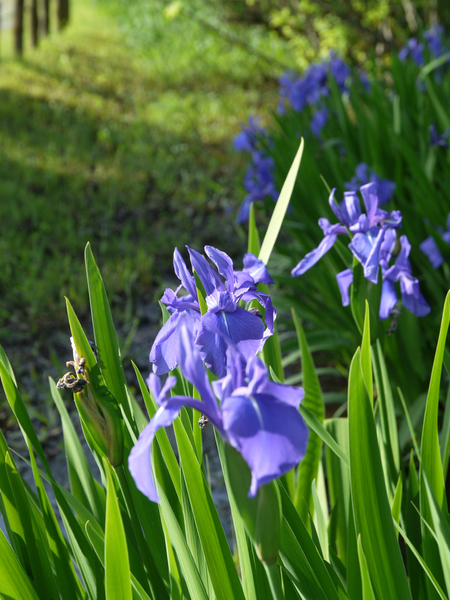
Iris laevigata (Japanese water iris, "Kakitsubata")
Japanese name: カキツバタ
Scientific name: Iris laevigata
[Overview]
A perennial that grows in sunny wet places such as the waterside of ponds and marshes.
The rhizome is branched and covered with many fibers.
The leaves are alternate in two rows, sword-shaped, 30–70 cm long and 2–3 cm wide, with an inconspicuous midrib.
Two or three flowers are borne at the tip of a flower stalk 40–70 cm tall.
The flowers are about 12 cm across and bluish purple; there are 6 tepals, and the 3 outer tepals are elliptic and hang down, with a white to cream-colored streak at the base.
The inner tepals are narrow and stand erect.
Each flower withers in a day.
The fruit is an oblong capsule 4–5 cm long.
[History]
It appears as early as the Man'yoshu, and has been composed in poems and used as a motif in crests and paintings.
Many cultivars were also created in the Edo period.
[Cultivation]
Propagate by division or from seed.
It prefers a sunny waterside.
For potted plants, sink the pot in a container so that the water covers the base of the plant, and change the water about once a month.
It is no problem if the water freezes in winter.
Care is needed because the water temperature rises during the hot summer period.
In autumn, bury slow-release solid fertilizer at the base of the plant.
If you are not collecting seed, cutting the flowers after they finish keeps the plant from becoming exhausted.
There are almost no pests or diseases, but pyralid moths may occasionally infest it.
[Notes]
It can be distinguished from Hanashobu by the white center of its petals.
In Hanashobu this part is yellow.
The Japanese name derives from "kakitsuke-bana" (「書き付け花」), from the practice of rubbing the flower juice onto cloth to dye it.
Writing it with the kanji 杜若 or 燕子花 is originally a mistake.
Details
Japanese: カキツバタ
Translated from our Japanese encyclopedia. If anything differs, the Japanese page is correct.