
Plant Encyclopedia

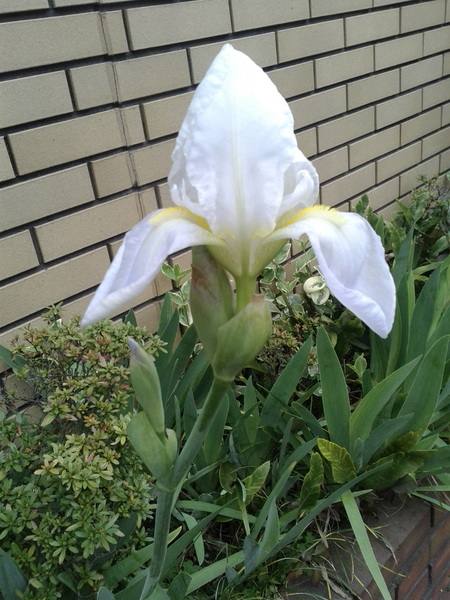
Iris florentina ("Nioiirisu")
Japanese name: ニオイイリス
Scientific name: Iris florentina
[Overview]
A perennial 40–100 cm tall, found in its native range in sunny mountain grasslands and similar places.
Thick rhizomes spread by creeping horizontally along the ground surface.
The rhizomes are covered with brown fibers and are fragrant.
The leaves are alternate in two ranks, sword-shaped, 30–70 cm long and 2.5–4 cm wide, with an inconspicuous midrib.
4–7 flowers are borne at the tip of the flower stalk.
The flowers are up to 25 cm across and white, sometimes pale blue.
There are 6 tepals; the 3 outer tepals hang down and have a yellow brush-like projection at the base.
The inner tepals stand upright.
[Cultivation]
Propagate by division.
It prefers a sunny, well-drained site.
Care is needed because heat, humidity and insufficient sunlight can cause disease.
For potted plants, water sufficiently when the soil surface dries.
For plants in the garden, watering is unnecessary unless it becomes extremely dry.
It is better kept on the dry side in summer.
In early spring and autumn, apply a small amount of slow-release fertilizer around the plant.
Crowded shoots cause disease and poor flowering, so repot potted plants every year and plants in the ground once every 2–3 years.
Pests and diseases include soft rot and aphids.
Details
Translated from our Japanese encyclopedia. If anything differs, the Japanese page is correct.