
Plant Encyclopedia

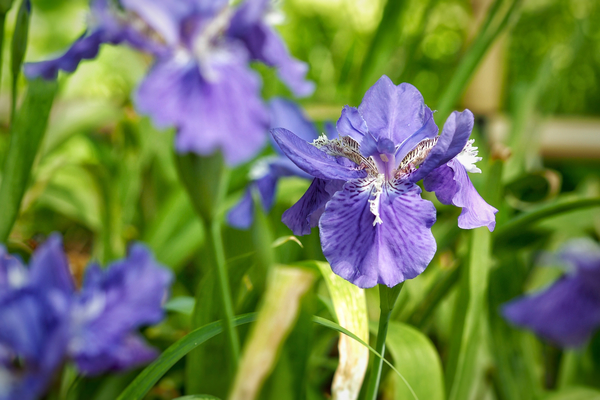
Iris tectorum (roof iris, "Ichihatsu")
Japanese name: イチハツ (一八、鳶尾)
Scientific name: Iris tectorum
[Overview]
A perennial 20–50 cm tall, growing at woodland edges and in pastures in its native range.
The rhizome is branched and yellow.
The leaves are alternate in two rows, sword-shaped, 15–60 cm long and 1.5–3.5 cm wide, with an inconspicuous midrib.
The flower stalks reach about 20–50 cm in height, branch somewhat, and bear 2–3 flowers at the tip of each branch.
The flowers are wisteria-purple, about 10 cm across, with 6 tepals; the 3 outer tepals are obovate with slightly wavy margins and have dark purple spots and streaks, and from the center to the base they are white with a crest-like projection.
The inner tepals are slightly narrower than the outer ones.
The fruit is an elliptical capsule 4 cm long.
[History]
Introduced from China long ago, it was planted on the ridges of farmhouses' thatched roofs as a charm to ward off strong winds.
[Uses]
The rhizome is used medicinally.
[Cultivation]
Propagate by division.
In sun to partial shade, it is not particular about soil as long as the site is well drained.
It prefers slightly moist places but tolerates dryness well.
For potted plants, water thoroughly when the soil surface dries.
For plants in the garden, watering is unnecessary unless it becomes very dry.
Fertilizer is not particularly necessary, but for potted plants a small amount of slow-release compound fertilizer with equal amounts of the three components may be placed on the soil three times: before budding, in autumn, and after flowering.
If you are not collecting seed, cutting the flowers off after they finish keeps the plant from becoming exhausted.
There are almost no pests or diseases, but the rice stem borer sometimes infests it.
[Notes]
It is said to have been named "Ichihatsu-gusa" because it blooms earliest among the ayame group of irises.
Details
Japanese: イチハツ(一八、鳶尾)、コヤスグサ、一初草
Translated from our Japanese encyclopedia. If anything differs, the Japanese page is correct.