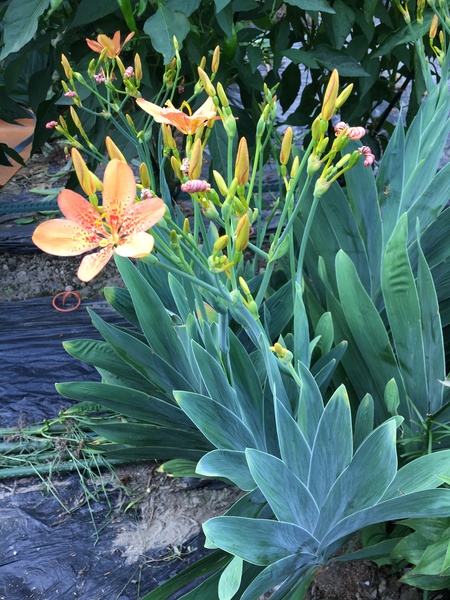
Japanese name: ヒオウギ(檜扇) Scientific name:Iris domestica
[Overview]
A perennial 60–100 cm tall, found in mountain grasslands.
It has rhizomes.
The leaves are alternate in two rows, sword-shaped, 30–50 cm long and 2–4 cm wide, and slightly tinged with a powdery white.
A raceme emerges at the tip of the flower stalk.
The flowers are about 3–4 cm across, orange with darker spots, and have 6 tepals that open flat.
The fruit is an elliptical capsule 3 cm long.
The seeds are spherical, glossy and black.
[Uses]
The rhizome is used medicinally.
The seeds are called "nubatama" or "ubatama" and are used in ikebana (flower arrangement).
[Cultivation]
Propagate from seed, by division, or by stem cuttings.
If the site is sunny and well drained, it grows well regardless of soil type.
For potted plants, water thoroughly when the soil has dried; for plants in the ground, rainfall is sufficient.
For fertilizer, place slow-release fertilizer on the soil in spring and autumn.
Pests and diseases include rust and soft rot.
[Notes]
The Japanese name compares the arrangement of the leaves to a hiogi (a fan made of cypress wood).