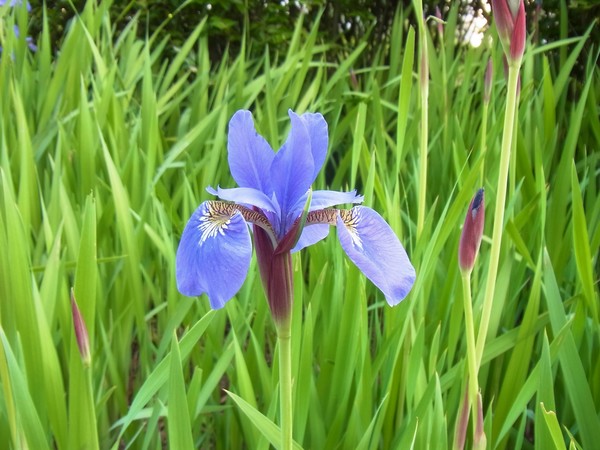
Japanese name: アヤメ(菖蒲) Scientific name:Iris sanguinea var. sanguinea
[Overview]
A perennial growing in dry mountain grasslands.
The rhizome is covered with brown fibers.
The leaves are alternate in two rows, sword-shaped, 30–50 cm long and 0.5–1 cm wide, with an inconspicuous midrib.
The flower stalks rise in clusters from the base, reach about 30–60 cm in height, and bear 2–3 flowers at the tip.
The flowers are purple, about 8 cm across, with 6 tepals; the 3 outer tepals are broadly ovate and have a yellow and purple net-like pattern at the base.
The inner tepals are narrow and stand upright.
Each flower wilts in a day.
The fruit is an oblong capsule 4 cm long.
[Cultivation]
Propagate by division or from seed.
It prefers a sunny location.
For potted plants, water thoroughly when the soil surface dries.
For plants in the garden, watering is unnecessary unless it becomes very dry.
If you are not collecting seed, cutting the flowers off after they finish keeps the plant from becoming exhausted.
There are almost no pests or diseases, but the rice stem borer sometimes infests it.
[Notes]
The Japanese name is said to derive from the twill-like pattern at the base of the outer tepals.