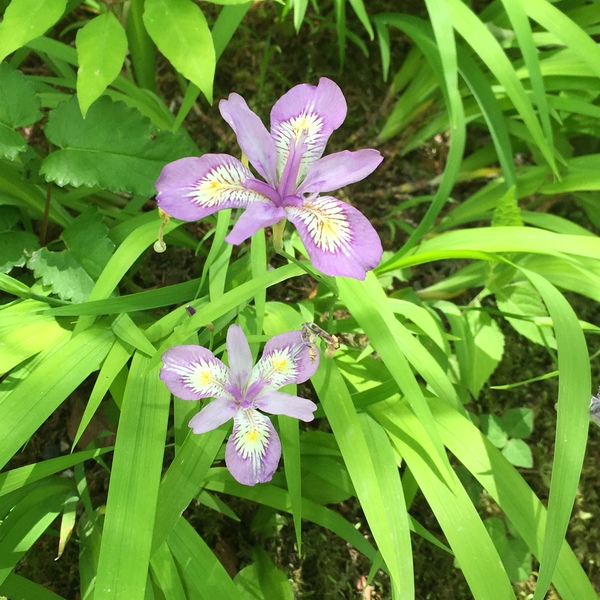
Japanese name: ヒメシャガ(姫射干) Scientific name:Iris gracilipes
[Overview]
A perennial found in slightly dry woods.
The leaves are alternate in two rows, sword-shaped, 20–40 cm long and 5–15 mm wide, and not glossy.
A raceme is produced on a flower stalk 30 cm or less in height.
The flowers are about 4 cm across and pale purple; there are 6 tepals, which open flat, and the 3 outer tepals have bluish purple veins and yellow markings.
The fruit is a spherical capsule about 8 mm across, and the seeds are reddish brown.
[Cultivation]
Propagate by division or from seed.
The seeds cannot be stored, so when growing from seed, sow them immediately after harvesting.
The fruits ripen in June–July while still green.
It prefers bright shade with good air circulation and well-drained soil.
For potted plants, water thoroughly when the soil surface dries.
It is weak against extreme dryness.
For plants in the garden, watering is not necessary unless it becomes very dry.
If you are not collecting seed, cutting the flowers after they finish keeps the plant from becoming exhausted.
Spider mites can occur.
[Notes]
It resembles Shaga, but can be distinguished by its leaves dying back in winter, its leaves lacking gloss, and its fewer and smaller flowers.