
Plant Encyclopedia

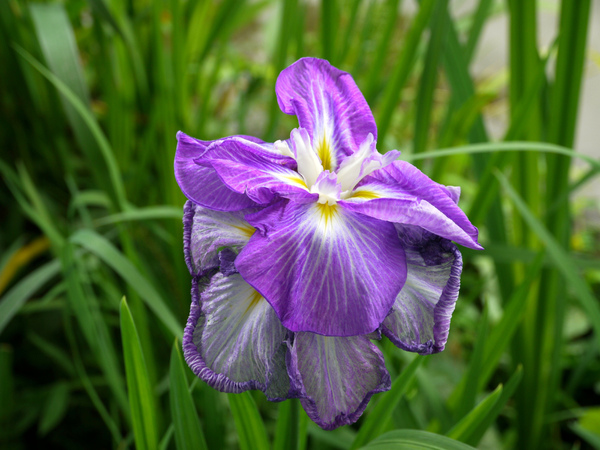
Iris ensata var. ensata (Japanese water iris, "Hanashobu")
Japanese name: ハナショウブ (花菖蒲)
Scientific name: Iris ensata var. ensata
[Overview]
A perennial growing about 50–100 cm tall.
A garden plant improved from the wild species Nohana-shobu.
The leaves are upright, flat and linear, with entire margins. The midrib is thick and clearly raised.
The flower stalk is also upright.
The center of the base of the outer tepals is tinged with yellow.
There are many cultivars, with a rich variety of flower colors.
Flower forms include the three-petal type (san'ei-zaki), in which the outer tepals are large and the inner tepals are not much developed; the six-petal type (rokuei-zaki), in which both outer and inner tepals are developed; double-flowered, ball-shaped (tama-zaki) and claw-shaped (tsume-zaki) types.
[History]
Horticultural breeding is said to have begun in the middle of the Edo period, and according to where the cultivars were bred, they are divided mainly into the following three lines.
Edo line: A line improved for growing in clumps in the ground. In general it is tall and vigorous, with a rich variety of flower forms and colors.
Ise line: A line improved for pot cultivation. The plants are short, and the flower stalks are about as tall as the leaves. Mostly three-petal type, and many have outer tepals that undulate like crepe and hang down.
Higo line: A line improved so that a potted plant displayed in a zashiki (tatami room) looks beautiful when viewed from the side. The plants are somewhat short, mostly six-petal type, and many have overlapping tepals that hang down.
In addition, there are the Nagai-koshu, a group of cultivars in Nagai, Yamagata, as well as those bred abroad and those bred by crosses between species.
[Cultivation]
Propagate by division or from seed.
It likes sun and is not particular about location as long as it does not become extremely dry.
Except during the flowering season, avoid letting the base of the plant stand in water.
From the time buds appear until flowering, give enough water so that it does not dry out. During this period, potted plants may be set in a tray of water (koshi-mizu).
Give organic fertilizer or liquid fertilizer three times: in early spring when it sprouts, after flowering, and in autumn.
It dislikes being grown repeatedly in the same place, so for plants in the ground, divide them and improve the soil after flowering. Potted plants are also best repotted every year.
There are no particular pests or diseases, but watch for cutworms, pyralid moths, and red spider mites when dry weather continues.
[Notes]
What is used in the shobu bath at the Tango no Sekku (Boys' Festival) is shobu of the family Araceae.
Details
Japanese: ハナショウブ(花菖蒲)
Translated from our Japanese encyclopedia. If anything differs, the Japanese page is correct.