
Plant Encyclopedia

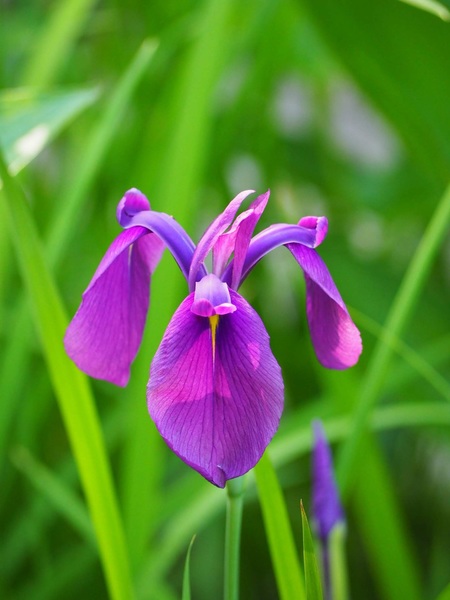
Iris ensata var. spontanea ("Nohanashobu")
Japanese name: ノハナショウブ (野花菖蒲)
Scientific name: Iris ensata var. spontanea
[Overview]
A perennial 40–80 cm tall, found in mountain grasslands and wetlands.
Because cattle and horses do not eat it, it often forms colonies in pastures.
The rhizome is branched and covered with brown fibers.
The leaves are alternate in two rows, sword-shaped, 30–60 cm long and 0.5–1.2 cm wide, with entire margins.
The midrib is thick and distinctly raised.
The flower stalk is also erect.
There are several bracts at the tip of the flower stalk, and the flowers bloom from within them.
The flowers are about 10 cm across and reddish purple.
There are 6 tepals; the 3 outer tepals hang down and are yellow at the center of the base.
The inner tepals stand erect.
The fruit is an elliptic capsule 2–3 cm long.
[Cultivation]
Propagate by division or from seed.
It prefers sun and is not particular about location as long as it is not extremely dry.
From the time buds appear until flowering, water generously so that it does not dry out.
At this time, potted plants may be stood in a tray of water.
Apply organic fertilizer or liquid fertilizer three times: in early spring when it sprouts, after flowering, and in autumn.
It dislikes being grown repeatedly in the same place, so for plants in the ground, divide them and improve the soil after flowering.
Potted plants are also best repotted every year.
There are no particular pests or diseases, but watch for armyworms, pyralid moths, and red spider mites when dry weather continues.
Details
Translated from our Japanese encyclopedia. If anything differs, the Japanese page is correct.