
Plant Encyclopedia

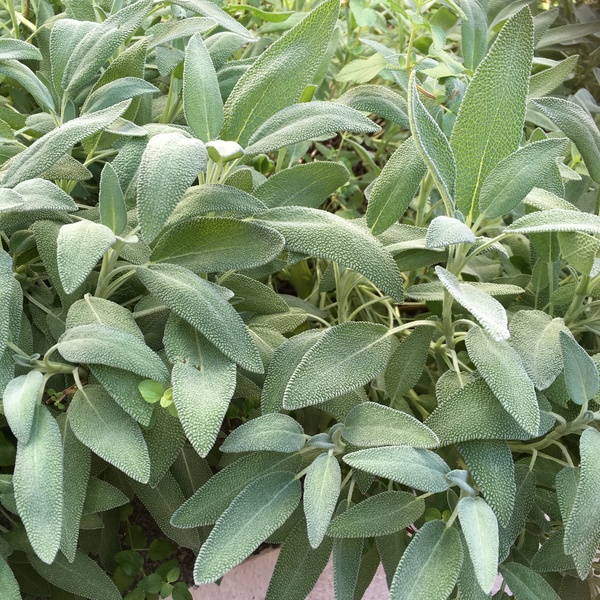
Salvia officinalis (sage)
Japanese name: セージ
Scientific name: Salvia officinalis
[Overview]
An evergreen perennial about 60 cm tall.
The whole plant is fragrant.
The stem has 4 ridges, branches well, and becomes woody at the base.
The leaves are simple and opposite, oblong, with many wrinkles on the upper surface, and covered all over with white down, especially on the underside, so the underside looks almost white.
The leaf stalks are long.
Verticillasters emerge at the stem tips.
The flowers are tubular and two-lipped, varying in color from white to pink or purple.
[Uses]
The leaves contain essential oil and medicinal compounds.
Fresh or dried leaves are used for herbal tea, and also to flavor meat dishes and cheese.
The essential oil is used as a fixative for perfume and in toothpaste and cosmetics.
When taken medicinally, excessive intake or long-term use is said to be inadvisable.
[Cultivation]
Propagate from seed, by division, or by cuttings.
It prefers a sunny, well-drained, well-ventilated place.
In poor light it may become leggy and weak.
Water thoroughly when the soil surface dries.
It is hardy, but dislikes summer heat and humidity, and if the plant becomes stuffy the inner and lower leaves may die, so thin out crowded branches to improve airflow.
To overwinter it outdoors, protect it from the cold, for example by laying straw around the base of the plant.
Details
Japanese: セージ、ヤクヨウサルビア、コモンセージ、ガーデンセージ
Translated from our Japanese encyclopedia. If anything differs, the Japanese page is correct.