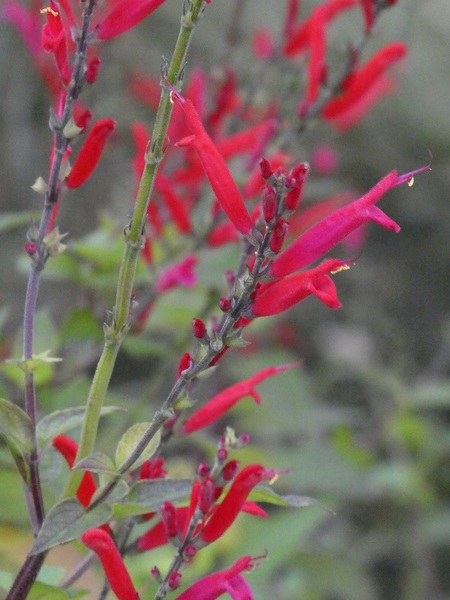
Japanese name: パイナップルセージ Scientific name:Salvia elegans
[Overview]
A subshrub about 1–1.5 m tall.
The stem has 4 ridges.
Leaves are simple and opposite, ovate, 5–10 cm long, with notches along the margin.
The leaves have a pineapple-like fragrance.
Whorled cymes are produced at the stem tips.
The flowers are about 4 cm long, scarlet red, tubular and two-lipped.
The protruding red styles are also very conspicuous.
[Uses]
The leaves and flowers are used to flavor dishes and for herbal tea, potpourri and dried flowers.
[Cultivation]
Propagate from seed, by division, or by cuttings.
It prefers fertile sites that are sunny and well drained.
In poor light it may become leggy and weak.
It is somewhat susceptible to cold, so to overwinter it outdoors, protect it from the cold, for example by laying straw around the base of the plant.
Bring potted plants indoors.
If the branches grow too long, cut them back short after flowering.