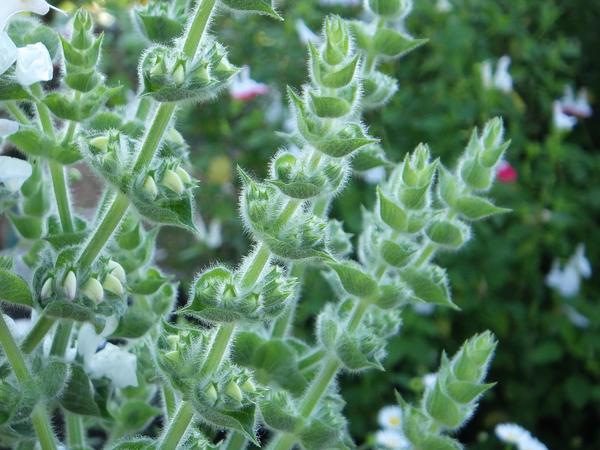
Japanese name: ビロードアキギリ Scientific name:Salvia argentea
[Overview]
A biennial or short-lived perennial 60–90 cm tall.
The whole plant is densely covered with soft white hairs.
Most leaves are basal, ovate to elliptic, 20–30 cm long and 15 cm wide, thick, and wrinkled along the veins.
The leaves on the stem are opposite.
The leaf margins have rounded teeth.
The young leaves look especially white, and turn gray-green at flowering time.
Verticillasters at the stem tips bear pinkish-white lipped flowers.
[Cultivation]
Propagate mainly from seed.
It dislikes heat and humidity, and is sometimes treated as an annual.
It prefers a sunny, well-drained, well-ventilated place.
In poor sunlight it may become leggy and weak.
Take care not to let it become too humid; for potted plants, water thoroughly when the soil surface dries, and for plants in the ground, rainfall is sufficient.
It tolerates dryness.
In spring, apply slow-release fertilizer placed on the soil.
If you do not need seed, cut off the flower spikes after flowering so the plant does not become exhausted.
There are no particular pests or diseases.