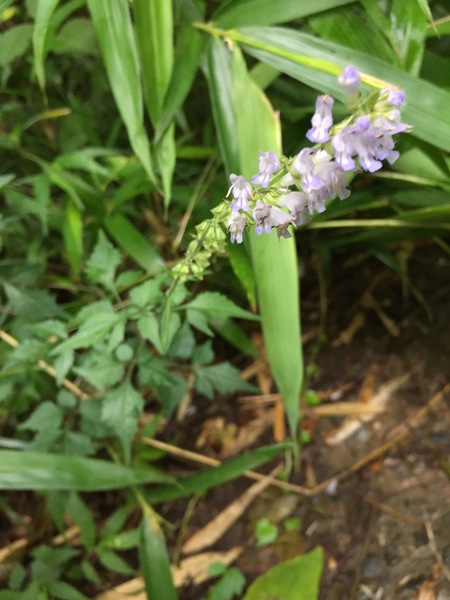
Japanese name: アキノタムラソウ(秋田村草) Scientific name:Salvia japonica
[Overview]
A perennial 20–80 cm tall, found in woods and along roadsides.
It is highly variable, with forms that spread by sending out creeping stems and strains that begin flowering around May.
Leaves are opposite, ternately compound or 1–2 times pinnately compound, and sometimes simple.
The leaf margin has teeth.
Flowers are borne sparsely on a flower spike 10–25 cm long, and the corolla is purple to bluish purple.
The fruit is a schizocarp.
[Uses]
The whole plant is used medicinally.
[Cultivation]
Propagate from seed or by division.
It prefers a sunny, well-drained, airy site.
For potted plants, water thoroughly after the soil dries; for plants in the ground, rainfall is sufficient.
If basal fertilizer is applied, no further fertilizing is particularly necessary, but for potted plants slow-release fertilizer may be placed on the soil in spring and autumn.
There are no particular pests or diseases.