
Plant Encyclopedia

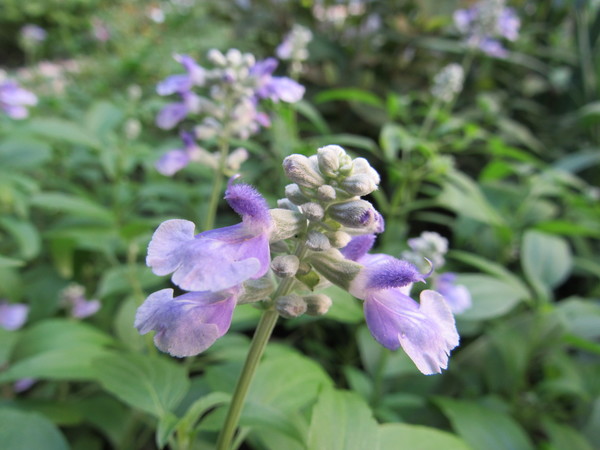
Salvia farinacea (mealycup sage)
Japanese name: サルビア ファリナセア
Scientific name: Salvia farinacea
[Overview]
A perennial 60 cm tall.
In regions where it dies back in winter cold, it is treated as an annual.
The leaves are simple and opposite, ovate to oblong-elliptic, about 8 cm long, hairless on the surface, with the margin almost entire or slightly toothed.
The leaves have long petioles.
A verticillaster 30–40 cm long arises at the stem tip and densely bears numerous flowers, so the whole inflorescence looks like a spike.
The flowers are bluish purple and lip-shaped.
The inflorescence and calyx are covered with white powder.
[Cultivation]
Propagate from seed or by shoot cuttings.
Germination requires a temperature of about 20°C, so sow in late April or later when the temperature rises.
The seeds need light to germinate, so sow in seed-sowing soil, do not cover them with soil, and water from the bottom so the soil does not dry out.
It can overwinter outdoors if not exposed to frost, and even if the aboveground part dies back in winter, it will sprout again in spring as long as it does not freeze.
If freezing is a concern, protect plants in the ground by laying straw around the base, and bring potted plants indoors.
It prefers fertile, weakly acidic soil that is sunny and well drained.
In poor light it may become leggy and weak, and flowering is also poorer.
Water thoroughly when the soil surface dries.
Lack of water causes the flowers and leaves to drop.
Except in midsummer, apply slow-release fertilizer once a month, or liquid fertilizer once every week to 10 days.
Cut off flower spikes that have finished blooming.
Cutting the plant back short after flowering to improve ventilation lets it grow again and flower again in autumn.
There are no particular pests or diseases, but aphids, spider mites and cutworms may infest it.
Details
Japanese: サルビア ファリナセア、ブルーサルビア、ケショウサルビア(化粧サルビア)
Translated from our Japanese encyclopedia. If anything differs, the Japanese page is correct.