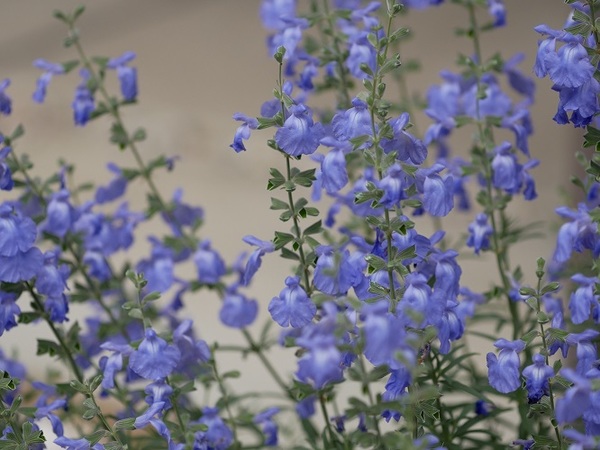
Japanese name: サルビア アズレア Scientific name:Salvia azurea
[Overview]
A perennial up to 1.5 m tall.
Leaves are simple and opposite, lanceolate to linear, about 5–10 cm long.
The leaf margins have fine serrations and marginal hairs.
The petiole is 1 cm long.
Verticillasters at the stem tips bear many flowers, so the whole inflorescence looks like a spike.
The flowers are blue and lipped, with a large, protruding lower lip marked with conspicuous white spots.
[Cultivation]
Propagate by stem cuttings or division.
It prefers a sunny, well-drained, well-ventilated place.
In poor light it may become leggy and weak, and flowering is also poor.
Take care not to make it too wet when watering; for potted plants, water thoroughly when the soil surface dries, and for plants in the ground, rainfall is sufficient.
In spring and autumn, place slow-release fertilizer on the soil.
Cut off flower spikes that have finished blooming.
Cutting back several times before flowering makes side shoots grow and increases the number of flowers.
There are no particular pests or diseases.