
Plant Encyclopedia

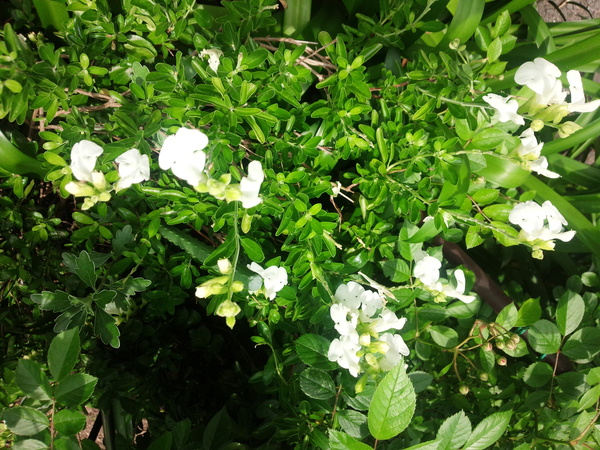
Salvia greggii (autumn sage)
Japanese name: サルビア グレッギー
Scientific name: Salvia greggii
[Overview]
An evergreen perennial to subshrub 60–90 cm tall.
It spreads sideways by underground stems, forming a clump about as wide as the plant is tall.
The stem is square in cross section.
The leaves are simple and opposite, ovate to elliptic, about 2–3 cm long, with margins that are almost entire.
The leaves have a minty fragrance.
The flowers are lipped and borne sparsely on long flower spikes, with a large, rounded, spreading lower lip.
The flowers are usually red, but may also be magenta, pink, orange or white.
[Cultivation]
Propagate by division or cuttings.
It tolerates temperatures down to -5°C, and even if the aboveground part dies back in winter, it will sprout again in spring as long as the roots do not freeze.
If freezing is a concern, protect plants in the ground by, for example, laying straw around the base, and bring potted plants indoors.
It prefers a sunny, well-drained, fertile site.
In poor light it may become leggy and weak, and flowering is poorer.
For potted plants, from spring to autumn water thoroughly when the soil surface dries, and keep it on the dry side in winter.
For plants in the ground, rainfall is sufficient.
No fertilizer is particularly needed if a base fertilizer is applied.
Although hardy, it is weak against summer heat and humidity, and if the plant becomes stuffy, the inner and lower leaves may die, so thin out crowded branches to improve ventilation.
There are no particular pests or diseases.
Details
Japanese: サルビア グレッギー、オータムセージ、アキノベニバナサルビア、チェリーセージ
Translated from our Japanese encyclopedia. If anything differs, the Japanese page is correct.