
Plant Encyclopedia

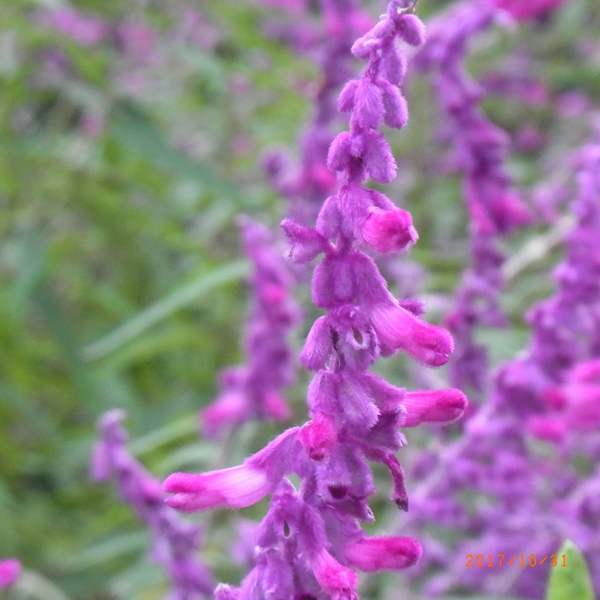
Salvia leucantha (Mexican bush sage)
Japanese name: サルビア レウカンサ
Scientific name: Salvia leucantha
[Overview]
An evergreen perennial to subshrub 1.3 m tall.
It sends out underground stems and spreads sideways, reaching a plant width of 2 m.
The whole plant is covered with many fine hairs.
The stem is square in cross section.
Leaves are simple and opposite, lance-shaped oblong, and sunken and wrinkled along the veins.
The undersides of the leaves are densely hairy.
The leaf margins are toothed.
The flowers are borne densely on long flower spikes; the corolla is white and the calyx is deep purple.
Both calyx and corolla are covered with fine hairs and look velvety.
[Uses]
The leaves are used medicinally and as a bath additive.
[Cultivation]
Propagate by division or cuttings.
It can overwinter outdoors if not exposed to frost, and even if the aboveground part dies back in winter, it sprouts again in spring as long as the roots do not freeze.
If freezing is a concern, give plants in the ground protection from the cold, for example by laying straw around the base, and bring potted plants indoors.
It prefers fertile, sunny, well-drained places.
In poor light it may become leggy and weak, and flowering is poorer.
For potted plants, water thoroughly when the soil surface dries from spring to autumn, and keep on the dry side in winter.
For plants in the ground, rainfall is sufficient.
No further fertilizer is particularly needed if base fertilizer is applied.
It is hardy, but weak against high temperature and humidity in summer; if the plant becomes stuffy, the inner and lower leaves may die, so thin out crowded branches to improve ventilation.
There are no particular pests or diseases.
Details
Japanese: サルビア レウカンサ、メキシカンブッシュセージ、アメジストセージ、メキシカンセージ、ベルベットセージ
Translated from our Japanese encyclopedia. If anything differs, the Japanese page is correct.