
Plant Encyclopedia

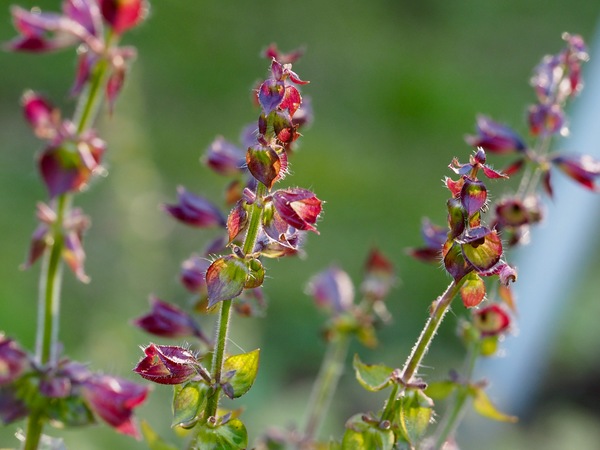
Salvia glabrescens var. glabrescens ("Akigiri")
Japanese name: アキギリ (秋桐)
Scientific name: Salvia glabrescens var. glabrescens
[Overview]
A perennial 20–60 cm tall, found in the shade of trees in the mountains.
The stem is square in cross section.
Leaves are simple and opposite, triangular-hastate, with teeth on the margin.
They have long leaf stalks.
Purple flowers are borne in verticillasters at the stem tips.
The corolla is lipped, and the inside is hairy and rough.
The fruit is a schizocarp.
[Cultivation]
Propagate from seed or by division.
It prefers a fertile, well-drained, moderately moist site.
A place in partial shade is good.
It is hardy and easy to grow.
Details
Names
Japanese: アキギリ(秋桐)、ミヤマアキギリ(深山秋桐)、オオアキギリ(大秋桐)
Life form
Perennial
Habit
Terrestrial
Planting (or sowing) season
April, May
Flowering season
August, September, October
Distribution or origin
Japan (Honshu: Hokuriku region to Kinki region)
Height
200–600 mm
Leaf shape
Simple leaf (unlobed)
Leaf arrangement
Opposite
Leaf margin
Serrate
Inflorescence
Verticillate cyme
Flower color
Purple
Leaf color
Green
Availability of seeds and plants
Low
Form sold
Seedlings
Propagation
Seed, Division
Sun exposure
Partial shade
Water needs
Moderate, Moist
Soil needs
Required
Tolerance
Cold tolerance
Suitable uses
Flower bed, Parks and gardens, Container
Designated plants
Endemic to Japan
Japan Flower Trade Code
42469
Translated from our Japanese encyclopedia. If anything differs, the Japanese page is correct.