
Plant Encyclopedia

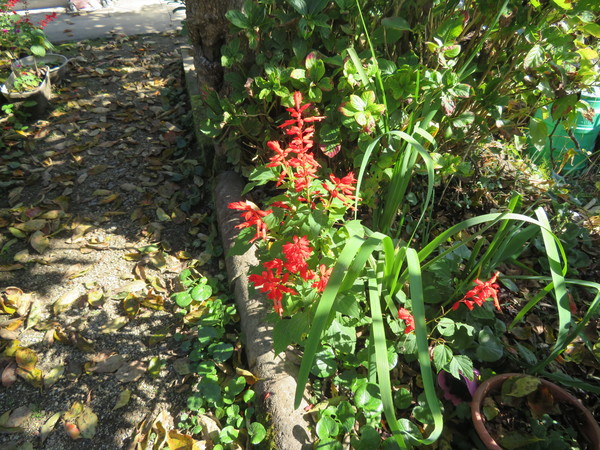
Salvia splendens (scarlet sage)
Japanese name: サルビア
Scientific name: Salvia splendens
[Overview]
A perennial that reaches about 60 cm in Japan but over 1 m in its native range.
In regions where it dies back in winter cold, it is treated as an annual.
The stem has 4 ridges and branches well.
The leaves are simple and opposite, ovate, about 5–9 cm long.
The leaf margins are serrate.
A spike-like verticillaster emerges at the stem tip.
The flowers are bright crimson, tubular and two-lipped, and the bell-shaped calyx is also bright crimson.
The flowers open in order from the bottom of the spike.
There are many garden varieties, with a wide range of flower colors such as white, pink and purple.
There are also varieties with red-and-white variegated flowers, and others with a white calyx and red corolla.
[Uses]
It is a popular flower bed plant.
[Cultivation]
Propagate from seed or by stem cuttings.
It prefers fertile, weakly acidic soil that is sunny and well drained.
It is somewhat weak in heat, and direct midsummer sun may weaken the plant, so a place out of the afternoon sun is suitable.
Water thoroughly when the soil surface dries.
If it dries out, the flowers and leaves drop, but if the soil stays too wet, the roots rot.
Except in midsummer, apply slow-release fertilizer once a month, or liquid fertilizer once every week to 10 days.
Cut off spent flower spikes.
Growth slows in the hot, humid season, so after flowering cut it back short to improve airflow; it then grows again in autumn and flowers once more.
In cool regions, flowers can be seen even in midsummer.
It can overwinter as long as it is not exposed to frost or freezing.
Germination requires a temperature of about 20°C, so sow from late April, when temperatures rise.
The seeds need light to germinate, so sow them in seed-starting soil without covering them with soil, and water from the bottom so the soil does not dry out.
There are no particular pests or diseases, but aphids, spider mites and cutworms may attack it.
Details
Japanese: サルビア、ヒゴロモソウ(緋衣草)、スカーレットセージ
Translated from our Japanese encyclopedia. If anything differs, the Japanese page is correct.