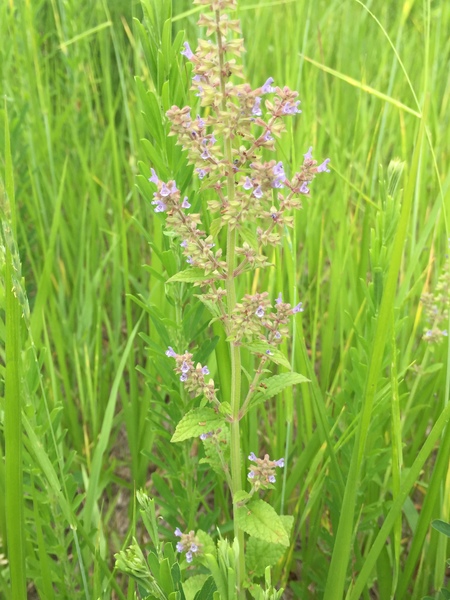
Japanese name: ミゾコウジュ(溝香薷) Scientific name:Salvia plebeia
[Overview]
A biennial or annual 30–70 cm tall, found in sunny, moist places such as paddy field ridges, damp grasslands and riverbeds.
The stem is erect and branched, square in cross section, and has downward-pointing fine hairs.
There are basal leaves and stem leaves; the basal leaves have long leaf stalks and have withered by the flowering period.
The stem leaves are simple and opposite, ovate-oblong, 3–6 cm long and 1–2 cm wide, with the surface wrinkled by depressions along the veins and covered with fine hairs.
The leaf margins have blunt serrations.
The leaf stalks are short.
Flower spikes appear at the stem tips and the tips of upper branches; they are short at first but later grow to 8–10 cm long.
The flowers are pale purple lipped flowers about 5 mm long, with 4 stamens, and the lower anthers are sterile and joined to each other.
The calyx is lipped; when flowering ends it closes its mouth from both sides, and it opens again at the fruiting stage.
The fruit is a schizocarp.