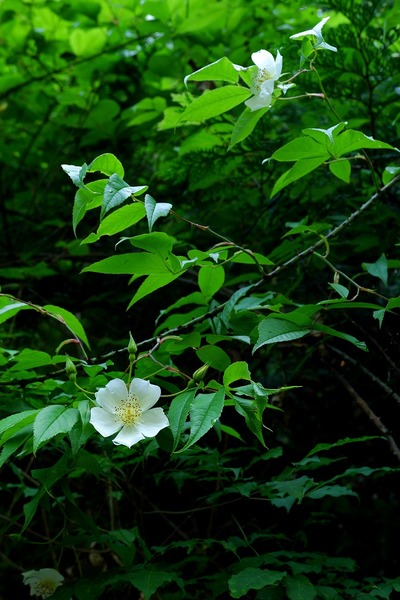
Japanese name: ヤマイバラ(山茨) Scientific name:Rosa sambucina
[Overview]
A climbing deciduous shrub found on wooded slopes along mountain streams and on seaside cliffs.
It may also hang down from cliffs.
The stems are thick and branched, and climb trees and cliffs supported by strong hooked thorns, reaching 10 m or more in length.
The leaves are alternate, odd-pinnately compound, 8–15 cm long, with 3–5 leaflets.
The leaflets are oblong to lanceolate, 5–8 cm long, sharply pointed at the tip and glossy on the upper surface; the leaf axis is hairless.
The leaf margins have sharp serrations.
The terminal leaflet is larger than the lateral leaflets.
The stipules are attached to the petiole up to the top and are entire, with soft hairs and glandular dots on the margin.
Corymbs to compound corymbs at the branch tips bear 1–20 white five-petaled flowers 4–5 cm across.
The flower stalks, calyx tube and sepals have soft hairs and glandular hairs.
The fruit is oblate, 0.8–1 cm across, and ripens red.
[Notes]
Plants distributed in Taiwan have more hairs on the inflorescence and calyx, and are sometimes distinguished as a variety.