
Plant Encyclopedia

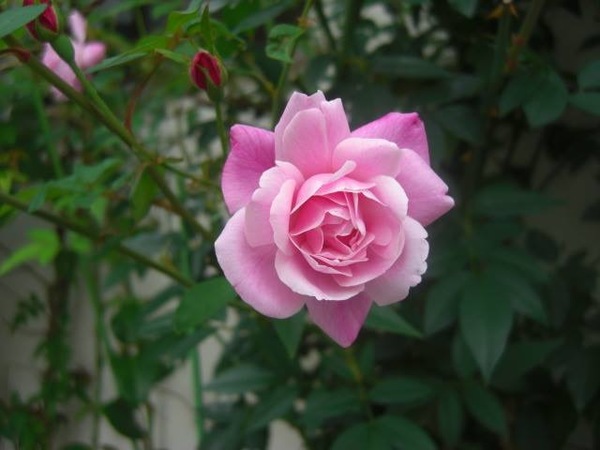
Rosa chinensis (China rose, "Koshinbara")
Japanese name: コウシンバラ (庚申薔薇)
Scientific name: Rosa chinensis
[Overview]
An evergreen shrub 1–2 m tall, or a woody plant with vining stems.
It branches well, and the twigs are often tinged purplish brown.
It may have curved, flattened thorns, or may have none.
The leaves are alternate and odd-pinnately compound, 5–11 cm long including the petiole, with 3–5 leaflets, rarely 7.
The leaflets are elliptic to ovate-elliptic, 2.5–6 cm long and 1–3 cm wide, with serrate margins.
The new shoots are often reddish purple.
The flowers are about 5 cm across, borne singly or in groups of 3–5.
The flowers are basically 5-petaled and pale pink to red, but because it has been cultivated since ancient times, various types are seen, such as double-flowered ones and those that are white, pale yellow or multicolored.
The fruit is ovoid to pear-shaped, 1–2 cm long, and ripens red.
[History]
It came to Japan early and is mentioned in the Meigetsuki.
It is the wild species that gave garden cultivars of rose their repeat-flowering habit.
[Uses]
In China the flowers are used as a crude drug.
[Cultivation]
Propagate from seed or by cuttings.
It prefers a sunny, well-drained, well-ventilated, fertile soil.
It is hardy and easy to grow.
It grows quickly and, if left alone, spreads into a large clump, so it needs space.
For potted plants, water thoroughly when the soil surface dries; for plants in the ground, rainfall is sufficient unless summer brings a long spell of sunny weather and the soil dries out.
Apply organic fertilizer in winter, and slow-release fertilizer after flowering in spring.
Pruning is basically not done, and the plant is left to its natural shape.
Pests include aphids, the rose sawfly (Arge pagana) and longhorn beetles.
Details
Japanese: コウシンバラ(庚申薔薇)、(月季花)、(長春花)
Translated from our Japanese encyclopedia. If anything differs, the Japanese page is correct.