
Plant Encyclopedia

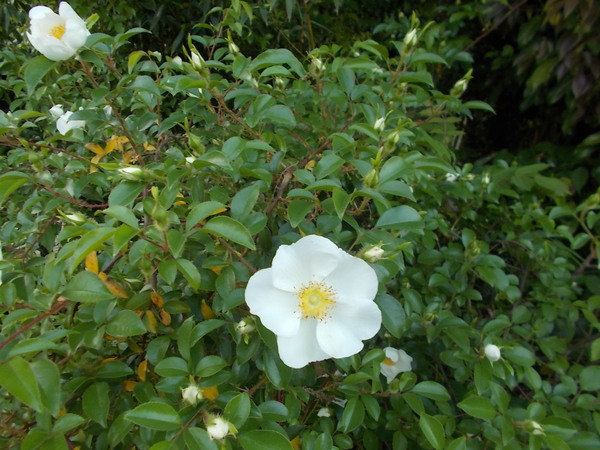
Rosa laevigata (Cherokee rose, "Naniwaibara")
Japanese name: ナニワイバラ (浪花茨、難波茨)
Scientific name: Rosa laevigata
[Overview]
An evergreen climbing woody plant.
The stems grow up to about 5 m, and the branches have strong, hooked prickles.
The leaves are alternate and odd-pinnately compound, consisting of 3 leaflets.
The leaflets are lanceolate-ovate, 2–6 cm long and 1.2–3.5 cm wide, thick and glossy, with fine, sharp teeth on the margin.
The flowers are white, 5-petaled, 5–10 cm across, and borne singly at the tips of twigs.
The flowers are fragrant.
Slender prickles grow densely on the outside of the flower stalk, the receptacle tube and the calyx, and remain in the fruiting period.
The fruit is pear-shaped, 3.5–4 cm long and 0.8–1.5 cm across, ripening reddish orange, with the erect sepals remaining.
[Uses]
The fruit is used as a crude drug.
[Cultivation]
Propagate from seed or by cuttings.
It prefers fertile soil in a sunny, well-drained, well-ventilated place.
It is hardy and easy to grow.
It grows fast and, if left alone, spreads into a large clump, so space is needed.
For potted plants, water thoroughly when the soil surface dries; for plants in the ground, rainfall is sufficient unless summer brings a long spell of sunny weather and the soil dries out.
Apply organic fertilizer in winter, and apply slow-release fertilizer after flowering in spring.
Basically it is not pruned and is left to its natural form.
Pests and diseases include aphids, rose sawflies and longhorn beetles.
Details
Japanese: ナニワイバラ(浪花茨、難波茨)、ナニワバラ(浪花薔薇、難波薔薇)
Translated from our Japanese encyclopedia. If anything differs, the Japanese page is correct.