
Plant Encyclopedia

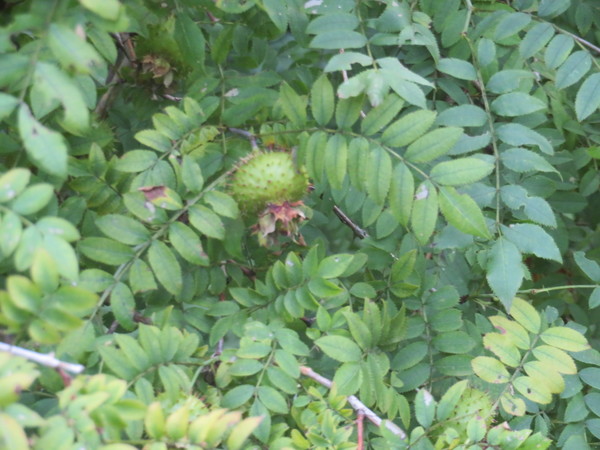
Rosa hirtula ("Sanshobara")
Japanese name: サンショウバラ (山椒薔薇)
Scientific name: Rosa hirtula
[Overview]
A deciduous shrub or small tree 2–6 m tall, found in deciduous forests in mountains in a limited area.
It is the largest of Japan's wild roses and, unusually for the genus Rosa, grows as a tree.
It usually stands upright like a tree, and the trunk can reach 10 cm in diameter.
It branches well, the branches bend in a zigzag, and there are thick, flattened thorns.
Leaves are alternate, odd-pinnately compound, about 7–15 cm long, with 9–19 leaflets.
The leaflets are oblong, 1–2.5 cm long, with soft hairs on the veins of the underside and on the leaf axis.
The leaf margins have fine teeth.
The flowers are borne singly at the branch tips and are pale pink with 5 petals, 4–6 cm across, with the petal tips slightly notched.
The flower stalk is thick and 1–1.5 cm long; it has thorns, as do the hypanthium and the outside of the calyx, and these remain in the fruiting period.
The fruit is flattened-spherical, 2 cm across, ripening yellow and giving off a sweet fragrance.
[Cultivation]
Propagate from seed or by cuttings.
It prefers fertile soil in a sunny, well-drained, well-ventilated place.
For potted plants, water thoroughly when the soil surface dries; for plants established in the ground, rainfall is sufficient unless summer brings a long sunny spell and the soil dries out.
Apply organic fertilizer as fertilizer in winter, and slow-release fertilizer after flowering in spring.
Pruning is basically not done, and the plant is left to its natural form.
Pests and diseases include aphids, spider mites and longhorn beetles.
[Notes]
The Japanese name comes from the leaves resembling those of Sansho.
It is designated as the town flower of Hakone, Kanagawa, and the village flower of Yamanakako Village, Minamitsuru District, Yamanashi.
Details
Translated from our Japanese encyclopedia. If anything differs, the Japanese page is correct.