
Plant Encyclopedia

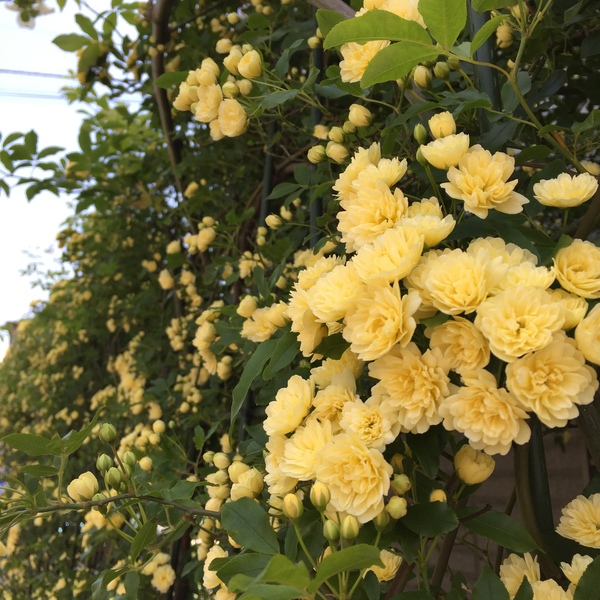
Rosa banksiae (lady Banks' rose, "Mokkobara")
Japanese name: モッコウバラ
Scientific name: Rosa banksiae
[Overview]
A climbing evergreen shrub that grows up to 6–7 m long.
The branches are green and have no thorns.
The leaves are alternate, odd-pinnately compound, 4–6 cm long, with 3–5 leaflets.
The leaflets are elliptic, 2–5 cm long and 0.8–1.8 cm wide, glossy on the upper surface, with fine serrations on the margins.
Corymbs are borne at the branch tips; the flowers are 2–3 cm across, white or yellow, and range from 5-petaled to double.
The white flowers are fragrant, but the yellow flowers have little scent.
The fruit is spherical to ovoid, 5–7 mm across, but some strains set fruit and some do not.
[History]
It was introduced to Japan in the middle of the Edo period.
The Ki-mokkobara is the personal emblem (oshirushi) of Princess Mako of the Akishino-no-miya family of the imperial household.
[Cultivation]
Propagate by cuttings.
It prefers a sunny, well-drained, well-ventilated, fertile soil.
It is hardy and easy to grow.
It grows quickly and, if left alone, spreads into a large plant, so space is needed.
For potted plants, water thoroughly when the soil surface dries; for plants in the ground, rainfall is sufficient unless summer brings a long spell of sunny weather and the soil becomes dry.
Apply organic fertilizer in winter, and apply slow-release fertilizer after spring flowering.
If the vines are held upright, flowers are slow to appear, so it is best to tie them in diagonally or horizontally.
Basically no pruning is done, and the plant is left to its natural form.
The flower buds for the following year form in August–September, so take care: pruning after this time will prevent flowering the next year.
Pests and diseases include aphids, rose sawflies and longhorn beetles.
Details
Japanese: モッコウバラ
Translated from our Japanese encyclopedia. If anything differs, the Japanese page is correct.