
Plant Encyclopedia

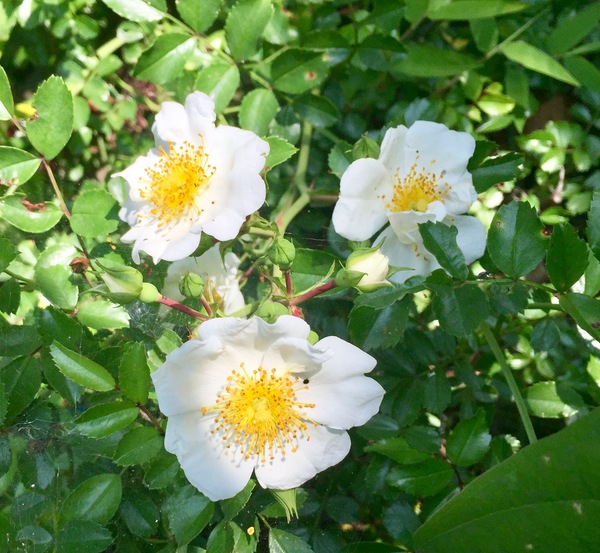
Rosa luciae ("Terihanoibara")
Japanese name: テリハノイバラ (照葉野茨)
Scientific name: Rosa luciae
[Overview]
A deciduous shrub commonly seen in sunny places such as coasts, riverbeds and mountain grasslands.
The stems are long and creep along the ground, and the branches have hooked prickles.
The leaves are alternate and odd-pinnately compound, with 7–9 leaflets.
The leaflets are round to broadly ovate, 1–2 cm long, thick and glossy, with coarse teeth on the margin.
The stipules are broad and have irregular teeth.
Short panicles at the branch tips bear white, 5-petaled flowers 3–3.5 cm across.
The fruit is elliptic to spherical, 0.8–1 cm long, ripening red and remaining until late autumn.
[History]
It is the wild species that brought the climbing habit to garden varieties of rose, and is the origin of the rambler and climbing groups.
[Uses]
The fruit is used as a crude drug.
[Cultivation]
Propagate from seed or by cuttings.
It prefers fertile soil in a sunny, well-drained, well-ventilated place.
It is hardy and easy to grow.
It grows fast and, if left alone, spreads into a large clump, so space is needed.
For potted plants, water thoroughly when the soil surface dries; for plants in the ground, rainfall is sufficient unless summer brings a long spell of sunny weather and the soil dries out.
Apply organic fertilizer in winter, and apply slow-release fertilizer after flowering in spring.
Basically it is not pruned and is left to its natural form.
Pests and diseases include aphids, rose sawflies and longhorn beetles.
Details
Translated from our Japanese encyclopedia. If anything differs, the Japanese page is correct.