
Plant Encyclopedia

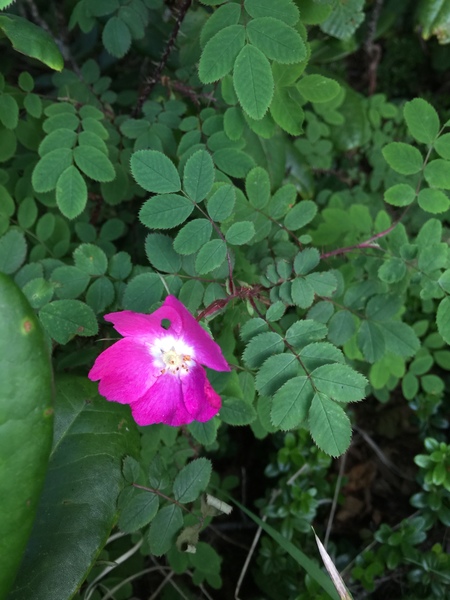
Rosa nipponensis ("Takanebara")
Japanese name: タカネバラ (高嶺薔薇)
Scientific name: Rosa nipponensis
[Overview]
A deciduous shrub 0.5–1.5 m tall, found in subalpine coniferous forest zones, in creeping pine zones, and on sunny rocky, gravelly ground.
Among the wild roses of Japan, it grows at the highest elevations.
It spreads by extending underground stems.
It branches well, and the branches are hairless, green at first and later dark purplish brown.
The prickles are straight, needle-like and tinged with white, of varying lengths; they are numerous on vigorous shoots but later drop off, and the side branches have few prickles.
The leaves are alternate and odd-pinnately compound, 4–10 cm long, with 7–11 leaflets.
The leaflets are oblong to elliptic, 2–3.5 cm long and 1–1.7 cm wide, with rounded tips, thin texture and little gloss.
The underside of the leaves is tinged with white, with soft, pressed-down hairs on the midrib and sparse slender prickles and glandular hairs.
The leaf margin has fine teeth that end in abrupt points.
The leaf axis has sparse slender prickles and glandular hairs; the stipules are fused to the leaf stalk for about two-thirds of their length, and glandular dots line the margin.
The prickles at the base of the leaf stalk are not distinct.
At the branch tips, one 5-petaled flower, reddish purple to pale reddish purple and 3.5–4 cm across, is usually borne.
The flower stalk is slender, 2–3 cm long, and has glandular hairs.
The receptacle tube and sepals are tinged with red.
The receptacle tube is narrowly spindle-shaped and hairless.
The sepals are lanceolate with long-extended tips and entire margins, and white woolly hairs grow densely on the outer margin and over the whole inner surface.
The flower is slightly fragrant.
The fruit (a false fruit) is obovate-spindle-shaped, 1.5–2.5 cm long, abruptly constricted at the tip, with the sepals standing erect at the apex, and ripens orange to red.
[Cultivation]
Propagate from seed, by cuttings, or by division of shoots.
It prefers a sunny, well-ventilated place with well-drained soil.
In warm regions, it is best kept cool in partial shade in midsummer.
For potted plants, water thoroughly when the soil surface dries; for plants in the ground, rainfall is sufficient unless summer brings a long spell of sunny weather and the soil dries out.
Apply organic fertilizer in spring and autumn.
Basically it is not pruned and is left to its natural form.
Pests and diseases include aphids, rose sawflies and longhorn beetles.
Details
Translated from our Japanese encyclopedia. If anything differs, the Japanese page is correct.