
Plant Encyclopedia

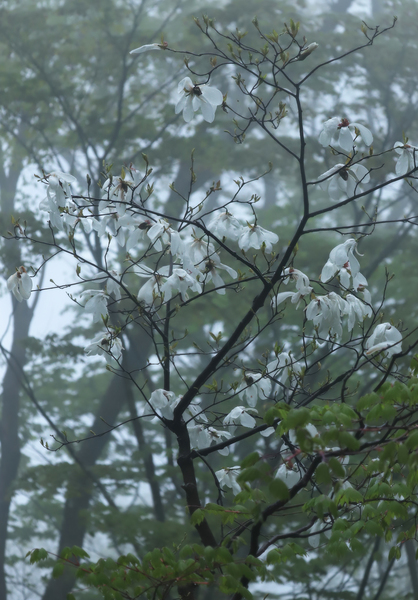
Magnolia salicifolia (willow-leafed magnolia, "Tamushiba")
Japanese name: タムシバ (嚙柴)
Scientific name: Magnolia salicifolia
[Overview]
A deciduous tree found mainly on the Sea of Japan side, sometimes reaching 10 m or more in height.
Cork-like projections sometimes form on the bark.
Leaves are simple and alternate, lanceolate to ovate, 6–12 cm long and 2–5 cm wide, with a wedge-shaped base narrowing and a pointed tip.
The undersides of the leaves are tinged with white.
The leaf margins are entire and slightly wavy.
The leaves are aromatic and taste sweet when chewed.
The leaf stalk is 1–1.5 cm long.
Stipule scars encircle the branch at the base of the leaf stalk.
The flowers open before the leaves emerge.
The flowers are about 10 cm across, white with 6 petals, and fragrant.
There are 3 sepals, which are hairless.
There are no leaves at the base of the flower.
The flower buds are several times larger than the leaf buds and are covered with long, silvery-white soft hairs.
The fruit is a follicle, an irregular oblong 7–8 cm long; when ripe it splits open and the red seeds hang from white thread-like tissue.
[Uses]
The buds are called shin'i and are used as a crude drug.
[Cultivation]
Propagate from seed or by grafting.
When grown from seed, it can take 10 years or more to flower.
It prefers sunny, well-drained, fertile sites with deep soil.
It dislikes dry places.
Because it grows large, it needs plenty of space.
Mature trees are difficult to transplant.
Pests and diseases are relatively few, but scale insects and longhorn beetles occur.
Details
Japanese: タムシバ(嚙柴)、ニオイコブシ(匂辛夷)
Translated from our Japanese encyclopedia. If anything differs, the Japanese page is correct.