
Plant Encyclopedia

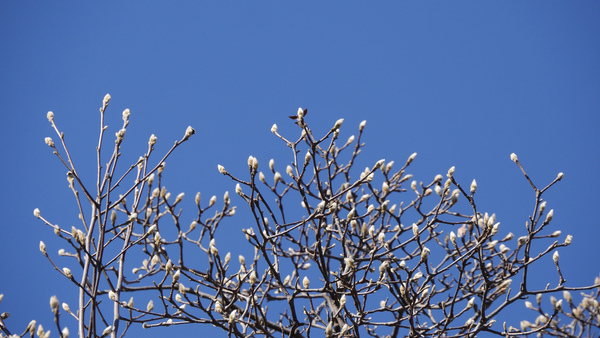
Magnolia denudata (yulan, "Hakumokuren")
Japanese name: ハクモクレン (白木蓮)
Scientific name: Magnolia denudata
[Overview]
A deciduous tree growing 15 m or more tall.
It is said to be native to China and has long been cultivated.
The bark is grayish white.
In old trees the branches spread out horizontally.
The leaves are alternate and obovate, 8–15 cm long, with entire, slightly wavy margins.
The leaf tip ends abruptly in a short point.
Stipule scars encircle the branch at the base of the leaf stalk.
The flowers open before the leaves emerge.
The flowers are milky white, about 15 cm across, and held upright.
There are usually 9 tepals, and a characteristic feature is that the outer 3 are small.
The flowers are fragrant.
The fruit is a follicle; when ripe it splits open and the red seeds hang from white thread-like tissue.
[History]
In China it was depicted in paintings of the Tang dynasty, and in Japan it arrived long ago and has been planted mainly at temples and similar places.
[Uses]
The buds are called "shin'i" in traditional Chinese medicine (kampo) and are used for headaches, rhinitis and other complaints.
[Cultivation]
Propagate from seed or by grafting.
When grown from seed, it can take 10 years or more to flower.
It prefers a sunny, well-drained site with deep soil.
It dislikes pruning, so limit it to cutting off unneeded branches.
Pests and diseases are relatively few.
Details
Japanese: ハクモクレン(白木蓮)、ハクレン(白蓮)
Translated from our Japanese encyclopedia. If anything differs, the Japanese page is correct.