
Plant Encyclopedia

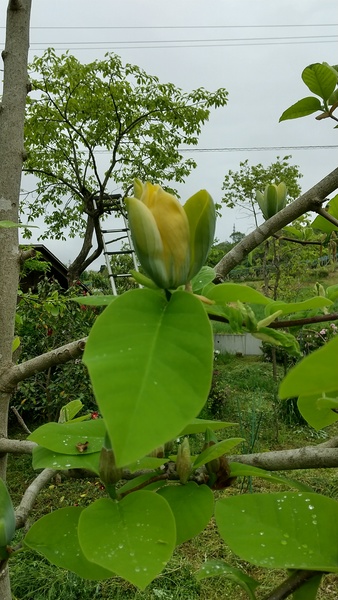
Magnolia acuminata (cucumber tree, "Kimokuren")
Japanese name: キモクレン (黄木蓮)
Scientific name: Magnolia acuminata
[Overview]
In its native range it is found in moist places along forest valleys and in woodland; a deciduous tree usually 10–20 m tall, sometimes reaching 30 m.
The crown is pyramidal.
The bark is dark grayish brown and fissured lengthwise.
The leaves are simple and alternate, elliptic to ovate, 12–25 cm long and 6–12 cm wide, with pointed tips and entire margins.
Stipule scars encircle the twig at the base of the petiole.
It flowers at the same time as the leaves unfold; the flowers are borne singly and upright at the tips of twigs, about 5–10 cm long, yellow-green to yellow, with 6 tepals.
The flowers are slightly fragrant.
The fruit is a follicle 6–8 cm long and 4 cm in diameter; when ripe it splits open and orange seeds hang from white thread-like tissue.
[Uses]
The buds and flowers are edible.
Native peoples of North America used bark extracts medicinally.
The wood can be used for plywood, utensils and the like.
[Cultivation]
Propagate from seed or by grafting.
When grown from seed, it can take 12 years or more to flower.
It is sensitive to air pollution, and transplanting a mature tree is difficult.
It prefers sun to partial shade and fertile, slightly acidic, moderately moist, well-drained soil with a deep soil layer.
It dislikes extremely dry or wet places.
Take care that it does not dry out; for potted plants, water thoroughly when the soil surface dries, and for plants in the ground, rainfall is sufficient unless sunny summer weather continues and the soil dries out.
Apply organic fertilizer as fertilizer in winter and also as thanks fertilizer after flowering.
It dislikes pruning, so limit it to cutting unneeded branches soon after flowering.
Pests and diseases are relatively few.
[Notes]
The English name comes from the young fruit resembling a cucumber.
Details
Japanese: キモクレン(黄木蓮)
Translated from our Japanese encyclopedia. If anything differs, the Japanese page is correct.