
Plant Encyclopedia

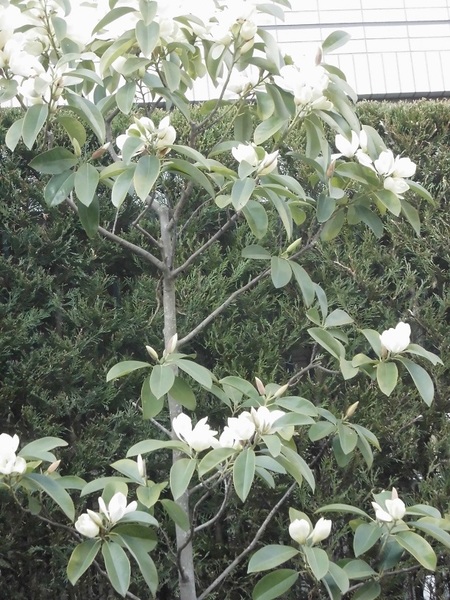
Magnolia virginiana (sweetbay magnolia, "Himetaisanboku")
Japanese name: ヒメタイサンボク (姫泰山木)
Scientific name: Magnolia virginiana
[Overview]
A deciduous or evergreen shrub to tree, sometimes over 30 m tall.
Its tree form and character vary with the growing environment.
The bark is gray and smooth.
Leaves are simple and alternate, oblong, 6–12 cm long and 3–5 cm wide; the upper surface is glossy and the underside is tinged with white.
The leaf margins are entire.
The flowers are borne singly at the branch tips, facing upward, about 8–14 cm across, white and fragrant.
There are 6–15 tepals.
The fruit is an oblong follicle 3–5 cm long, which splits when ripe to release red seeds.
[Uses]
The bark, leaves and seeds are used medicinally.
[Cultivation]
Propagate from seed or by cuttings.
It prefers a sunny, well-drained, fertile site with deep soil.
Because it grows large, it is unsuitable for pots and needs plenty of space.
Transplanting a mature tree is difficult.
Rainfall is sufficient for watering.
Apply slow-release chemical fertilizer three times: in early summer before flowering, in autumn, and as fertilizer in winter.
Because it has few branches, do not prune but only thin out branches; if pruning is done, do it as soon as possible after flowering.
Pests and diseases are relatively few, but scale insects and longhorn beetles occur.
Details
Japanese: ヒメタイサンボク(姫泰山木)、ウラジロタイサンボク(裏白泰山木)、バージニアモクレン
Translated from our Japanese encyclopedia. If anything differs, the Japanese page is correct.