
Plant Encyclopedia

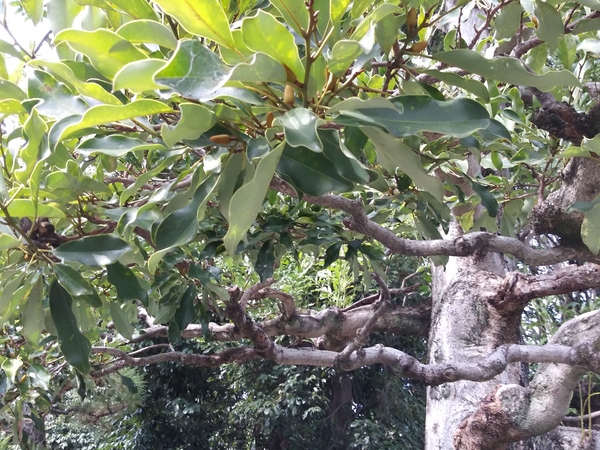
Magnolia compressa ("Ogatamanoki")
Japanese name: オガタマノキ (招霊木、小賀玉木)
Scientific name: Magnolia compressa
[Overview]
An evergreen tree 7–15 m tall, found in evergreen broadleaf forests from hills to low mountains.
Yellowish brown appressed hairs grow on young branches, buds, leaf stalks and other parts.
The leaves are simple and alternate, oblong-obovate to elliptic, 5–14 cm long and 2–5 cm wide, with a shortly protruding tip; they are leathery, glossy on the upper surface, whitish on the underside, and the margins are entire.
The leaf stalk is 2–3 cm, and a stipule scar encircles the branch at its base.
The flowers are solitary in the leaf axils, 3–4 cm across, with 12 tepals; they are cream-colored, 6-petaled, with the base tinged purplish red.
The flowers are fragrant.
The fruit is an aggregate fruit 5–10 cm long; the ovoid to spherical segments (follicles) split open when ripe, and orange seeds appear.
[Uses]
It is used in Shinto rituals and planted at shrines and similar places.
The wood is hard and is used for furniture and other purposes.
[Cultivation]
Propagate from seed.
It is sensitive to air pollution and dislikes transplanting when large.
It prefers a warm climate and is somewhat sensitive to cold, so protect it from frost, cold wind and strong wind.
It prefers sun to partial shade and well-drained, slightly moist, fertile soil.
It dislikes dryness and strong afternoon sun.
For potted plants, water thoroughly when the soil surface dries.
For plants in the ground, rainfall is sufficient unless summer brings a long spell of sunny weather and the soil dries out.
In poor soil, apply organic fertilizer in winter.
Prune only by thinning to improve airflow, about once every 2–3 years, immediately after flowering.
Avoid cutting thick branches or the trunk.
Scale insects can occur.
[Notes]
The Japanese name is said to derive from "ogitama" (招霊).
It is the personal emblem of Prince Hitachi Masahito.
It is a food plant of Mikado-ageha.
Details
Translated from our Japanese encyclopedia. If anything differs, the Japanese page is correct.