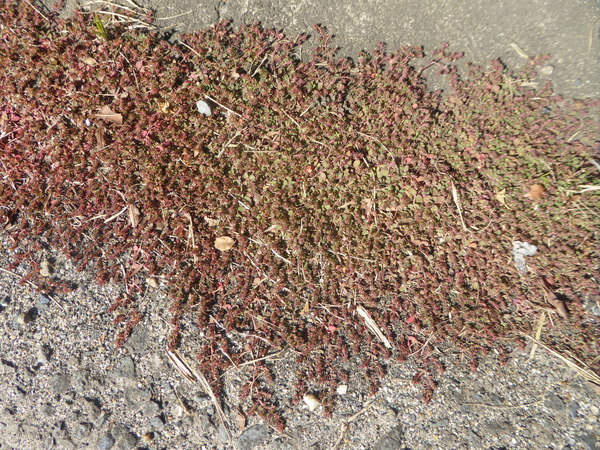
Euphorbia prostrata(prostrate spurge, "Hainishikiso")
Japanese name: ハイニシキソウ(這錦草) Scientific name:Euphorbia prostrata
[Overview]
An annual found along roadsides and on lawns.
When the stem or leaves are damaged, a milky-white latex comes out.
The stems creep along the ground, branch freely, and have short soft hairs on the upper side.
The leaves are simple and opposite, elliptical, about 0.3–0.8 cm long and 0.2–0.5 cm wide, with low serrations on the margins.
The leaf base is asymmetrical.
The leaves have triangular stipules.
In Okinawa and the Ogasawara Islands, it flowers all year round.
One cup-shaped inflorescence (cyathium) is produced at a time from the nodes of the leaves or of the reduced leaves.
The flowers are small, and the appendages of the glands are indistinct.
The fruit is a broadly ovate capsule 1.3 mm in diameter, with 3 ridges and hairs on the ridges.
[History]
Its invasion was confirmed in the Ryukyu Islands and the Ogasawara Islands before the war, and it is now confirmed as naturalized in the Kanto region and areas to the south.