
Plant Encyclopedia

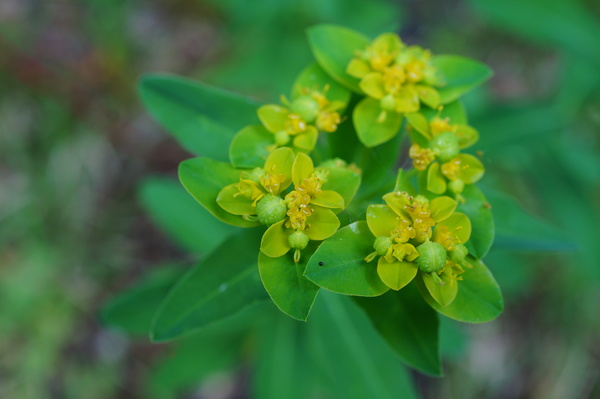
Euphorbia helioscopia (sun spurge, "Todaigusa")
Japanese name: トウダイグサ (灯台草)
Scientific name: Euphorbia helioscopia
[Overview]
A biennial about 10–50 cm tall, found along roadsides, in fields, and on river embankments.
It has no rhizome, and the roots are thin.
White milky sap comes out when the stems or leaves are damaged.
The stem is 8–50 cm long and hairless or covered with white hairs; the base of the stem is slightly creeping or rises obliquely, and often branches at the base.
The leaves are simple and alternate, borne in large numbers, spatulate to obovate, 1–4 cm long and 0.5–1.7 cm wide, with fine teeth on the upper half.
There are no leaf stalks or stipules.
Five leaves are borne in a whorl-like cluster at the branch tip, and 5 flowering branches radiate from there.
The flowering branches first divide into 2–3 forks, and then divide into 2 forks.
Elliptic to ovate bracts are borne at the tips of the flowering branches, and a cyathium emerges from their center.
During the flowering season, the leaves on the upper part of the stem turn yellow, like the bracts.
The flowers have no petals.
The fruit is an ovate, smooth capsule.
The seeds are black, with a caruncle, and have a net-like ridged pattern on the surface.
[Uses]
Although it is a poisonous plant, it is used as a folk medicine for external use.
[Notes]
The Japanese name likens the plant's form in the flowering season to a todai, an old lighting device.
Details
Japanese: トウダイグサ(灯台草)、スズフリバナ(鈴振花)
Translated from our Japanese encyclopedia. If anything differs, the Japanese page is correct.