
Plant Encyclopedia

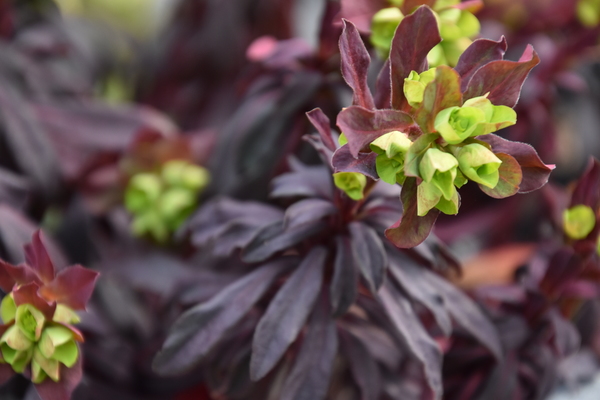
Euphorbia amygdaloides (wood spurge)
Japanese name: ユーフォルビア アミグダロイデス
Scientific name: Euphorbia amygdaloides
[Overview]
An evergreen perennial 30–80 cm tall, found in its native range in forested areas.
White milky sap comes out when the stems or leaves are damaged.
It spreads by extending underground stems and forms a mound.
The stem is erect and usually unbranched.
The leaves are simple and alternate, spatulate to oblanceolate, 6–7.5 cm long, green, and tinged purple to reddish purple in winter.
Flowering branches arise at the stem tips, ovate bracts form at the tips of the flowering branches, and a cyathium emerges from their center.
The flowers are enclosed in a yellowish green urn-shaped involucre and have no petals.
The fruit is a capsule.
[Cultivation]
Propagate from seed, by division, or by cuttings.
For cuttings, wash off the white milky sap right away by rinsing the cut end with water or placing it in water, then let the cut end dry before inserting it.
It prefers dry soil in a sunny, airy, well-drained site, but in warm regions it is better in partial shade or a place sheltered from afternoon sun in midsummer.
If the light is too poor, the plant's shape becomes untidy and flowering and leaf color suffer.
It dislikes heat and humidity.
Take care not to let it become too moist; for potted plants, water thoroughly when the soil dries from spring to autumn, and keep it on the dry side in winter.
For plants in the ground, rainfall is sufficient.
It tolerates dryness well.
It is best fertilized sparingly; apply a small amount of slow-release fertilizer in spring and autumn, so that no fertilizer remains in midsummer.
Pests and diseases include rust, powdery mildew and scale insects.
[Notes]
It is a poisonous plant, and the milky sap may cause a rash if it touches the skin.
Details
Japanese: ユーフォルビア アミグダロイデス
Translated from our Japanese encyclopedia. If anything differs, the Japanese page is correct.