
Plant Encyclopedia

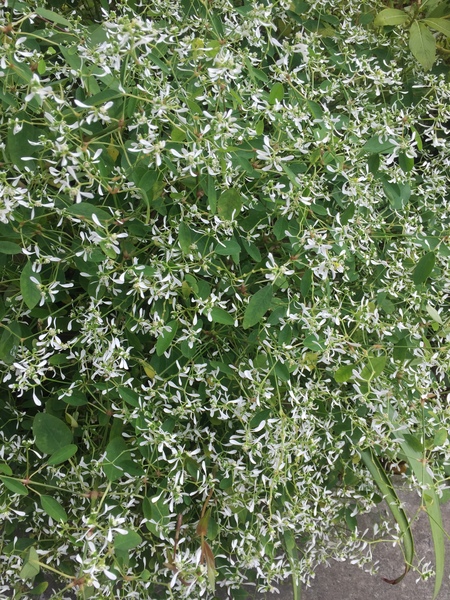
Euphorbia (genus)
Japanese name: ユーフォルビア(ダイアモンド フロストなど)
Scientific name: Euphorbia
[Overview]
A perennial or evergreen low shrub.
It is not cold-hardy, so in Japan it is mainly treated as an annual.
A milky white latex comes out when the stems or leaves are damaged.
The stem branches freely.
The leaves are simple and alternate, obovate to elliptic.
At the branch tips the leaves are whorled-like and become white-colored bracts.
Small flowers are borne at the center of the bracts.
The flowers are borne in cyathia enclosed by urn-shaped involucres, and have no perianth.
The fruit is a spherical capsule.
[Cultivation]
Propagate by stem cuttings.
It is sensitive to cold, so if you wish to overwinter it, bring it indoors in early autumn when temperatures fall to 15°C or below.
If it is hit directly by heater air, it dries out and the leaves fall.
It prefers fertile soil with good drainage and water retention, in a sunny place.
In poor light, the bracts color poorly and the lower leaves may fall.
If drainage is poor, the roots may rot in the hot season.
For potted plants, during the growing period from spring to autumn, water when the soil surface dries and apply chemical fertilizer once a month.
In winter, water sparingly, and during flowering apply liquid fertilizer once a week.
For plants in the ground, rainfall is sufficient; apart from base fertilizer, apply chemical fertilizer once a month.
It tolerates dryness.
In mid-April, cutting it back hard, leaving 2–3 nodes from the base of the stem, gives a well-balanced shape afterward.
Cultivars with a strong short-day response will not flower, and the bracts will not color well, unless the daily light exposure is 12 hours or less.
Therefore, until the bracts color after late September, avoid exposing the plants to artificial light at night, and every day from 17:00 until morning cover them with a cardboard box or similar to block the light.
Pests and diseases include greenhouse whiteflies and scale insects.
Details
Translated from our Japanese encyclopedia. If anything differs, the Japanese page is correct.