
Plant Encyclopedia

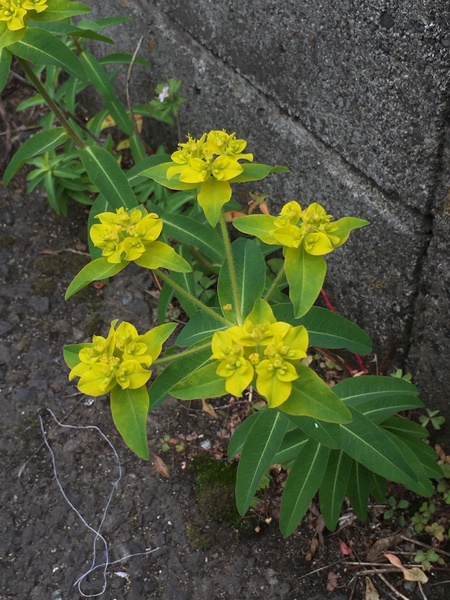
Euphorbia adenochlora ("Norushi")
Japanese name: ノウルシ (野漆)
Scientific name: Euphorbia adenochlora
[Overview]
A perennial about 30–60 cm tall, found on riverbeds and in wetlands.
The rhizome is well developed and forms dense colonies.
The aboveground parts die back by summer and the plant goes dormant.
White milky sap comes out when the stems or leaves are damaged.
The stem is 22–65 cm long, erect, and branches in the upper part.
The stem leaves are simple and alternate, elliptic, about 4.5–10 cm long and 1–3.3 cm wide, with entire margins.
There are no petioles or stipules.
Five leaves are borne in a whorl-like arrangement at the branch tips, and five flower branches radiate from there.
The flower branches first divide into 2–3 forks and then into 2 forks.
At the tip of each flower branch are elliptic to broadly elliptic bracts, and a cyathium emerges from their center.
During flowering, the leaves on the upper part of the stem turn yellow, like the bracts.
The flowers have no petals.
The fruit is a spherical capsule with conical protrusions arranged in 6 rows.
The seeds are black, smooth, and have a caruncle.
[Notes]
It is a poisonous plant, and the Japanese name comes from the fact that the milky sap causes a rash if it gets on the skin.
Details
Translated from our Japanese encyclopedia. If anything differs, the Japanese page is correct.