
Plant Encyclopedia

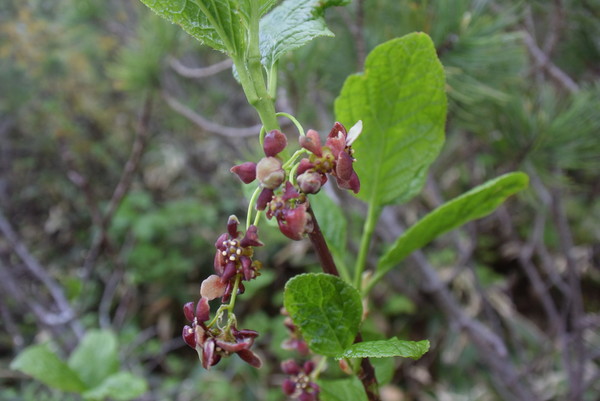
Euonymus tricarpus ("Kurotsuribana")
Japanese name: クロツリバナ (黒吊花)
Scientific name: Euonymus tricarpus
[Overview]
A deciduous small tree 2–3 m tall, common in heavy-snow regions on the Sea of Japan side, found at the edges of subalpine forests and on avalanche slopes.
The current year's twigs are green, the previous year's twigs are purplish brown, and old branches are gray.
The leaves are simple and opposite, elliptic, 2.5–12 cm long and 1.5–9 cm wide, with the upper surface wrinkled and sunken along the veins.
The leaf margins have fine serrations.
The leaf stalk is 0.5–1 cm long.
The flowers are borne, 3–7 together, in cymes that emerge beside the bud-scale scars of the new twigs.
The inflorescence has a stalk 2–4 cm long and hangs down.
There are male and female flowers; the male flowers have 5 petals and the female flowers 3 petals, and they are about 8 mm across and dark purple to dark reddish brown.
The fruit is a spherical capsule about 1 cm across with 3 broad wings spreading downward.
The fruit ripens red and splits into 3, releasing vermilion seeds.
[Cultivation]
Propagate from seed or by cuttings.
It prefers soil that is well drained and retains water well.
Grow it in a sunny place, but strong direct sunlight in summer can cause leaf scorch, so it is better to keep it in partial shade in summer.
For potted plants, and for plants in the ground less than 2 years after planting, water thoroughly when the soil surface dries.
For established plants in the ground, rainfall is sufficient unless sunny weather continues in midsummer and the soil becomes severely dry.
Apply organic fertilizer around the plant as fertilizer in winter.
Pests and diseases include powdery mildew and scale insects.
Details
Translated from our Japanese encyclopedia. If anything differs, the Japanese page is correct.