EVERGREEN

Plant Encyclopedia

Euonymus fortunei var. fortunei

Euonymus fortunei var. fortunei ("Tsurumasaki")

Japanese name: ツルマサキ (蔓柾、蔓正木)
Scientific name: Euonymus fortunei var. fortunei

Euonymus fortunei var. fortunei

[Overview]
An evergreen woody vine found in forests.
It produces aerial roots and creeps along the ground or climbs other plants.
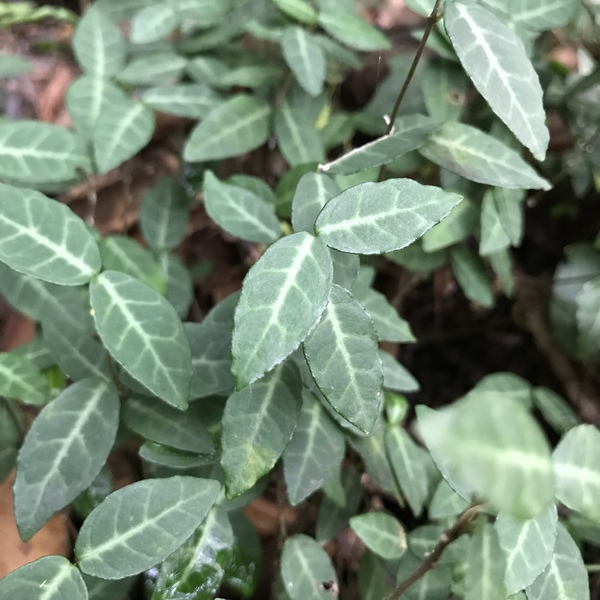
Leaves are simple, usually opposite, sometimes whorled or alternate, elliptical, 1.5–6 cm long and 0.7–3 cm wide, thick and glossy, with low wavy serrations on the margin.
The petiole is 0.3–1 cm long.
Cymes 1.5–8 cm long emerge from the leaf axils, bearing 7–31 flowers.
The inflorescence has a stalk of 1–6 cm.
The flowers are pale green with 4 petals, 0.5 cm across.
The fruit is a spherical capsule about 0.5–0.6 cm across, ripening pale red and splitting into four to release glossy vermilion seeds.

[Uses]
The stems and leaves are used medicinally.

[Cultivation]
Propagate by division or cuttings.
It grows well in any soil as long as the site is sunny.
It also tolerates partial shade.
For plants less than 2 years after planting, water thoroughly when the soil surface dries.
For established plants in the ground, rainfall is sufficient unless midsummer brings a long spell of sunny weather and the soil becomes severely dry.
Apply organic fertilizer around the plant as fertilizer in winter.
Powdery mildew and scale insects can occur.

Details

Names
Japanese: ツルマサキ(蔓柾、蔓正木)、ナガバツルマサキ(長葉蔓柾、長葉蔓正木)、マルバツルマサキ(丸葉蔓柾、丸葉蔓正木)、リュウキュウツルマサキ〔CR〕(琉球蔓柾、琉球蔓正木)
Life form
Woody climber
Evergreen / deciduous
Evergreen
Leaf type
Broadleaf
Habit
Terrestrial
Planting (or sowing) season
April, May, September, October
Flowering season
June, July
Fruiting season
October, November
Distribution or origin
Japan (Hokkaido to Ryukyu), East Asia to India
Growth form
Climbing
Leaf shape
Simple leaf (unlobed)
Leaf arrangement
Opposite, Alternate, Whorled
Leaf margin
Undulate, Serrate
Inflorescence
Cyme
Number of petals
4
Flower color
Green
Flower diameter
5
Inflorescence length
15–80
Fruit color
Red, Pink
Leaf color
Green
Availability of seeds and plants
Low
Form sold
Seedlings
Propagation
Cuttings, Division
Sun exposure
Full sun
Water needs
Moderate
Soil needs
Required
Tolerance
Cold tolerance
Suitable uses
Ground cover, Rock garden, Hedge, Topiary, Parks and gardens
Diseases
Powdery mildew
Pests
Scale insects
Uses
Medicinal
Japan Flower Trade Code
20798

Translated from our Japanese encyclopedia. If anything differs, the Japanese page is correct.

Sponsored