
Plant Encyclopedia

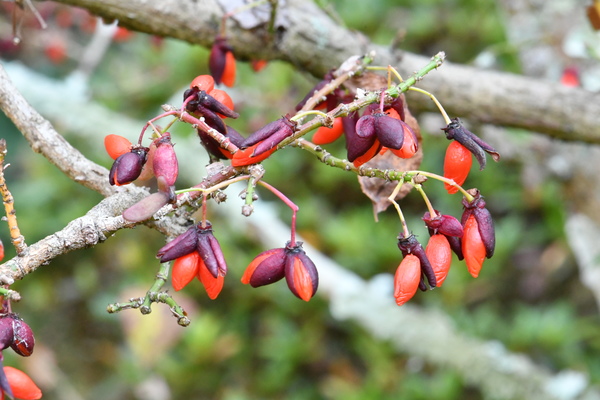
Euonymus alatus var. alatus f. alatus (winged spindle, "Nishikigi")
Japanese name: ニシキギ (錦木)
Scientific name: Euonymus alatus var. alatus f. alatus
[Overview]
A deciduous shrub growing to 3 m tall.
The branches have four corky, plate-like wings, which develop as the branches age and can reach 5 mm wide.
Leaves are simple and opposite, obovate to oblong, 1–9 cm long and 0.5–4.5 cm wide, with fine serrations on the margin.
The petiole is 0.1–0.3 cm long, with early-falling stipules on both sides of the base.
The leaves turn brilliant red in autumn.
Beside the bud scale scars at the base of the current year's branches, cymes 1–4 cm long emerge, bearing 1–7 flowers.
The inflorescence has a stalk of 0.2–3 cm, and the flower stalks are 0.3–0.6 cm.
The flowers are about 0.6–0.8 cm across, with 4 yellow-green petals.
The fruit is an elliptical split fruit about 0.5–0.8 cm long, ripening dark reddish purple and splitting open to hang out vermilion seeds.
[Uses]
The bark is used medicinally.
[Cultivation]
Propagate from seed or cuttings.
It prefers fertile, sunny, well-drained soil.
It tolerates partial shade, but the autumn color is poor if the sunlight is insufficient.
For potted plants, and for plants in the ground less than 2 years after planting, water thoroughly when the soil surface dries.
For established plants in the ground, rainfall is sufficient unless midsummer brings a long spell of sunny weather and the soil becomes severely dry.
Apply organic fertilizer around the plant as fertilizer in winter.
If pruning, do it while the plant is leafless.
Scale insects can occur.
[Notes]
The Japanese name compares the beauty of its autumn leaves to brocade.
Details
Japanese: ニシキギ(錦木)、アオハダニシキギ、オオバニシキギ(大葉錦木)
Translated from our Japanese encyclopedia. If anything differs, the Japanese page is correct.