
Plant Encyclopedia

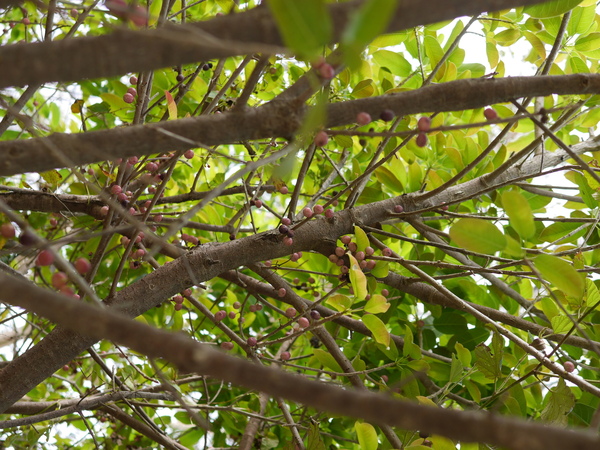
Ficus subpisocarpa (sea fig, "Ako")
Japanese name: アコウ (雀榕、榕、赤榕、赤秀)
Scientific name: Ficus subpisocarpa
[Overview]
An evergreen tree reaching as much as 20 m.
A white milky sap comes out when the leaves or stems are damaged.
It produces many aerial roots from the trunk and branches.
The leaves are simple and alternate, elliptic, 8–15 cm long and 4–8 cm wide, with entire margins.
There are 6–8 pairs of lateral veins.
The petiole is 4–6 cm long.
Several times a year, before new buds emerge, it drops all its leaves at once.
Knob-like protrusions appear in the leaf axils or beside the scars of fallen leaves, and bear 1–3 spherical syconia (fig-type flask-shaped flower receptacles), 8 mm across.
The flowers are cauliflorous, with the syconia attached directly to the trunk and branches.
The syconium has 3 bracts that fall early.
The flowers grow on the inside of the syconium, so the fruit ripens with no flowers visible from the outside.
Inside the syconium are male flowers, female flowers and gall flowers, and pollination is carried out by the fig wasp Akou-kobachi.
After flowering, the syconium becomes a fruiting syconium (the fruit).
The fruiting syconium is spherical, 1 cm across, and ripens to white tinged with pale pink.
The fruiting syconia are edible.
The seeds are dispersed by birds; in the wild they germinate on trees and grow as epiphytes, and as they grow they may cover the host tree with their aerial roots and kill it.
For this reason it is also called the strangler tree.
[Cultivation]
Propagate by cuttings or layering.
It prefers sun.
It is heat tolerant and withstands temperatures down to 0°C in winter, so it can be grown outdoors in warm regions.
Details
Japanese: アコウ(雀榕、榕、赤榕、赤秀)、アコギ、アコミズキ
Translated from our Japanese encyclopedia. If anything differs, the Japanese page is correct.