
Plant Encyclopedia

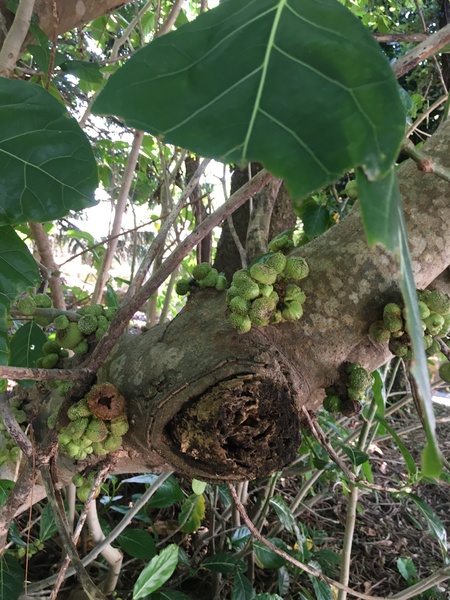
Ficus septica ("Obainubiwa")
Japanese name: オオバイヌビワ (大葉犬枇杷)
Scientific name: Ficus septica
[Overview]
An evergreen tree found in woods.
A white milky sap comes out when the leaves or stems are damaged.
Young branches are hairless.
The leaves are simple and alternate, elliptic, 10–20 cm long and 6–11 cm wide, and hairless on both sides.
The leaf surface is glossy, and the veins stand out in white.
The leaf margin is entire.
The petiole is 1.5–3.5 cm long, and there are lanceolate stipules 2–3 cm long.
It is dioecious.
One oblate syconium (fig-type flask-shaped flower receptacle), 1.3 cm across, is borne in each leaf axil.
The flowers grow on the inside of the syconium, so the fruit ripens with no flowers visible from the outside.
After flowering, the syconium becomes a fruiting syconium (the fruit).
The fruiting syconium is oblate, 2 cm across, and ripens to greenish brown.
[Uses]
The fruit and the white latex are used medicinally.
[Cultivation]
Propagate from seed, by cuttings, or by layering.
It prefers moderately moist soil with good sun and good drainage.
Immediately after planting, water thoroughly when the soil dries; for established plants, rainfall is sufficient unless summer brings a long spell of sunny weather and severe dryness.
Apply organic fertilizer around the plant as fertilizer in winter.
There are no particular pests or diseases.
Details
Translated from our Japanese encyclopedia. If anything differs, the Japanese page is correct.