
Plant Encyclopedia

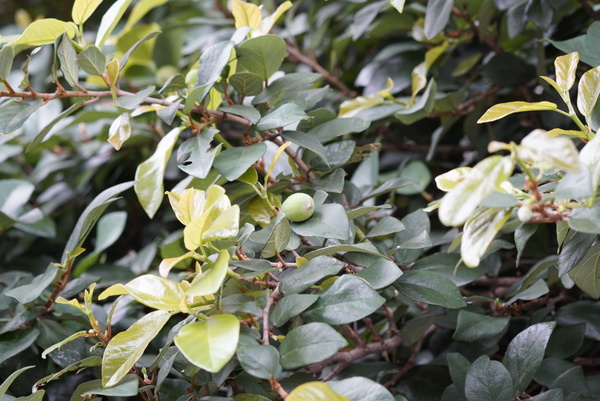
Ficus pumila (creeping fig, "Oitabi")
Japanese name: オオイタビ (大崖爬)
Scientific name: Ficus pumila
[Overview]
An evergreen woody climber.
A white milky sap comes out when the leaves or stems are damaged.
It produces adventitious roots from the trunk and extends by creeping over trees and rocks.
The stems and petioles of young plants are densely covered with short appressed hairs.
The leaves are simple and alternate; young leaves are triangular-ovate to lanceolate, about 3 cm long, with entire margins.
Mature leaves are elliptic, 4–10 cm long and 3–5 cm wide, with entire margins.
The petioles of mature leaves are at first densely covered with short appressed hairs, but later become somewhat hairless.
It is dioecious.
One syconium (fig-type flask-shaped flower receptacle) is borne in each leaf axil.
The flowers grow on the inside of the syconium, so the fruit ripens with no flowers visible from the outside.
After flowering, the syconium becomes a fruiting syconium (the fruit).
The fruiting syconium is obovate to spherical, 3.5–5 cm long and 3–4 cm wide, and ripens to purplish black.
The fruiting syconia of female inflorescences are edible.
[Uses]
Plants in the young-leaf stage are used as foliage plants.
[Cultivation]
Propagate by cuttings or layering.
It prefers sun, but avoid direct midsummer sunlight because it causes leaf scorch.
It is heat tolerant and overwinters if the temperature stays at or above 0°C in winter, so keep it in a bright place such as by a window.
For potted plants, from spring to autumn water thoroughly when the soil surface dries, and keep it on the dry side in winter.
Also mist the leaves with water.
For plants in the ground, rainfall is sufficient.
From spring to autumn, give liquid fertilizer once every 2 weeks, or place slow-release solid fertilizer on the soil once every 2 months.
Pests and diseases include spider mites, scale insects and aphids.
Details
Japanese: オオイタビ(大崖爬)、オオイタビカズラ(大崖爬蔓)、フィカス プミラ、プミラ
Translated from our Japanese encyclopedia. If anything differs, the Japanese page is correct.