
Plant Encyclopedia

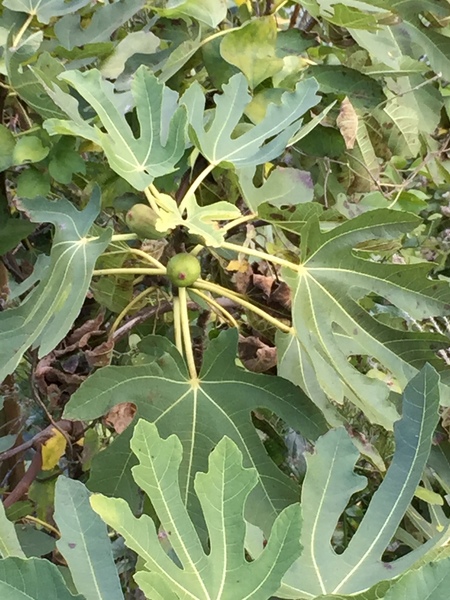
Ficus carica (common fig, "Ichijiku")
Japanese name: イチジク (無花果)
Scientific name: Ficus carica
[Overview]
A small deciduous tree about 3–6 m tall.
White milky sap comes out when the leaves or stems are damaged.
The leaves are simple, alternate, large, palmately divided into 3–5 lobes, and fleshy.
The undersides of the leaves are densely hairy.
Obovate-spherical flower sacs are borne on short branchlets in the leaf axils.
Because the flowers are borne inside the flower sac, the fruit ripens with no flowers visible from the outside.
The flower sac is pale green, and there are male and female flowers, with the male flowers in the upper part and the female flowers in the lower part of the same flower sac.
Most cultivars bear only female flowers.
After flowering, the flower sac becomes a fruit sac (the fruit).
The fruit sac is a modified flower axis and receptacle, obovate, and usually turns dark purple when ripe, though the color differs depending on the cultivar.
[History]
It is the oldest cultivated fruit tree.
It has long been regarded as the tree of life and the tree of wisdom.
In Mesopotamia it has been cultivated for more than 6,000 years, and it was also eaten in ancient Greece and ancient Rome.
It also appears in the Old Testament and is regarded as a symbol of peace and abundance.
It came to Japan by way of Persia and China, arriving in Nagasaki in the early Edo period, and was at first cultivated for medicinal use.
[Uses]
The fruit sacs are eaten.
The milky sap from cut surfaces of the leaves and stems, and the branches and leaves, are used medicinally.
[Cultivation]
Propagate by cuttings or grafting.
It prefers a place with good sun, drainage, and water retention.
It is somewhat weak in cold tolerance, so it is not suited to outdoor cultivation in the northern Kanto region and north of it.
When planted in the garden, no special watering is needed unless the weather stays dry; for potted plants, water when the soil surface dries.
Apply basal fertilizer in November–January and additional fertilizer in June–July.
Prune in December–February.
Care is needed, because cutting the branches back too much prevents fruiting.
Ripe fruit is vulnerable to rain and easily damaged by birds, so care is needed.
Pests and diseases include phytophthora blight, anthracnose, black mold, violet root rot, stem blight, mosaic disease, sclerotinia rot, cobweb disease, rust, longhorn beetles, nematodes, and scale insects.
Details
Japanese: イチジク(無花果)、ホウライシ(蓬莱柿)、ナンバンガキ(南蛮柿)、トウガキ(唐柿)
Translated from our Japanese encyclopedia. If anything differs, the Japanese page is correct.