
Plant Encyclopedia

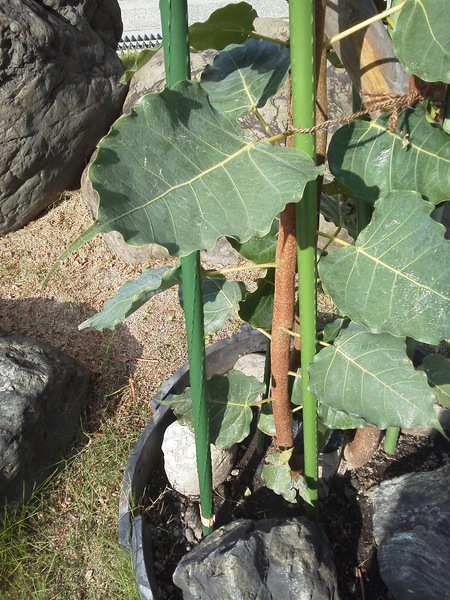
Ficus religiosa (bodhi tree, "Indobodaiju")
Japanese name: インドボダイジュ (印度菩提樹)
Scientific name: Ficus religiosa
[Overview]
An evergreen tree reaching as much as 30 m.
It is long-lived, and some trees are over 1000 years old.
When the leaves or stems are damaged, a white milky sap emerges.
It produces many aerial roots from the trunk and branches.
The leaves are simple and alternate, broadly ovate, 10–17 cm long and 8–12 cm wide, with a long tail-like tip.
The leaf margin is entire.
The petiole is 6–10 cm long.
Oblate syconia are borne in the leaf axils or beside the scars left by fallen leaves.
The syconia are attached directly to the trunk and branches, making it cauliflorous.
The flowers are borne inside the syconium, so the fruit ripens with no flowers visible from the outside.
The fruiting syconium is oblate, 1–1.5 cm across, ripening to reddish purple with red spots.
The seeds are dispersed by birds; in the wild they germinate and grow as epiphytes on trees, and as they grow the aerial roots may cover the host tree and kill it.
For this reason it is also called the strangler tree.
[History]
It is said that the Buddha attained enlightenment under this tree, and it is regarded as a sacred tree in Buddhism, Hinduism and Jainism.
In Japanese temples, the linden Bodaiju (a Tilia species) is often planted as a substitute for the Indian Bodaiju.
[Uses]
The bark, root bark and so on are used medicinally.
[Cultivation]
Propagate by cuttings or air layering.
It prefers sun.
It tolerates heat and withstands winter temperatures down to 0 °C, so it can be grown in the open ground in warm regions.
When grown as a foliage plant, keep it in a bright place such as by a window in winter.
For potted plants, from spring to autumn water thoroughly when the soil surface dries, and in winter keep it on the dry side.
Also mist the leaves with water.
From spring to autumn, give liquid fertilizer once every 2 weeks, or place slow-release solid fertilizer on the soil once every 2 months.
Pests include spider mites, scale insects and aphids.
Details
Japanese: インドボダイジュ(印度菩提樹)、テンジクボダイジュ(天竺菩提樹)
Translated from our Japanese encyclopedia. If anything differs, the Japanese page is correct.