
Plant Encyclopedia

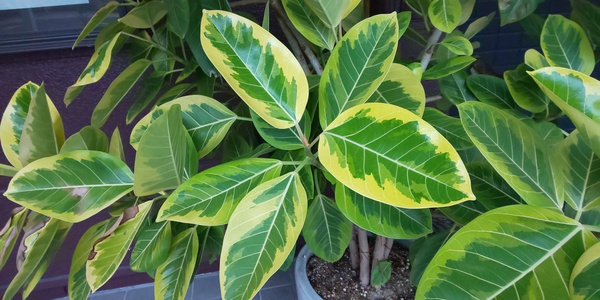
Ficus altissima (council tree)
Japanese name: フィカス アルティッシマ
Scientific name: Ficus altissima
[Overview]
An evergreen tree grown as a foliage plant.
In its native range it reaches 30 m in height, produces aerial roots, and develops buttress roots.
White milky sap comes out when the leaves or stems are damaged.
The leaves are simple and alternate, elliptic to ovate, 10–15 cm long and 4–10 cm wide, thick, with conspicuous pale veins and a glossy surface.
One or two syconia form in the leaf axils, and because the flowers are borne inside the syconium, the fruit ripens with no flowers visible from the outside.
The fruit is elliptic to ovate and orange.
The seeds are dispersed by birds; in the wild they germinate on trees and grow as epiphytes, and as they grow, their aerial roots may cover the host tree and kill it.
For this reason it is also called the strangler tree.
[Uses]
The bark is used for rope.
The sap can be used as a raw material for natural rubber.
[Cultivation]
Propagate by cuttings or air layering.
It prefers fertile soil in a sunny, well-drained site.
It is safest to keep it at 5°C or above over winter, and in winter it is kept in a bright place such as by a window.
For variegated cultivars, 10°C or above is ideal to preserve the coloring.
It may drop its leaves when exposed to cold.
From spring to autumn, water thoroughly when the soil surface dries, and keep it on the dry side in winter.
In summer it should be kept hot and humid, and in winter it tends to dry out, so misting the leaves with a sprayer is beneficial.
In spring and autumn, apply slow-release fertilizer placed on the soil.
Indoors, dust easily collects on the leaves, so wipe them occasionally with a lightly moistened cloth.
Pests and diseases include powdery mildew, anthracnose, spider mites, scale insects and aphids.
Details
Japanese: フィカス アルティッシマ、フィカス アルテシーマ
Translated from our Japanese encyclopedia. If anything differs, the Japanese page is correct.