
Plant Encyclopedia

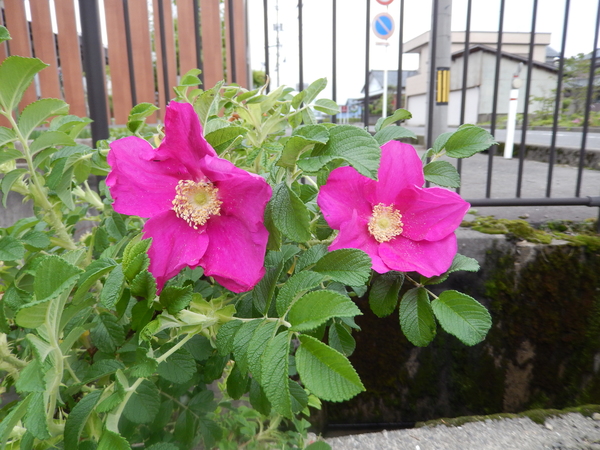
Rosa rugosa (rugosa rose, "Hamanasu")
Japanese name: ハマナス (浜茄子)
Scientific name: Rosa rugosa
[Overview]
A deciduous shrub 0.5–1 m tall, often growing in colonies on the seashore.
The stems branch freely, and the branches are densely covered with stout flattened thorns and thin needle-like thorns.
The leaves are alternate and odd-pinnately compound, 5–13 cm long, with 7–9 leaflets.
The leaflets are elliptical, 1.5–4.5 cm long and 1–2.5 cm wide; the upper surface is sunken along the veins and wrinkled, and glossy.
The underside of the leaf and the leaf axis are densely covered with white soft hairs.
The leaf margins have serrations.
A corymb at the branch tip bears 1–3 purplish-red, 5-petaled flowers 6–9 cm across.
The flower stalk is stout, 1–3 cm long, and has thorns.
The flowers have a strong fragrance.
The fruit is oblate, 2–2.5 cm across, and ripens orange to red.
[History]
It is the personal emblem of Her Majesty Empress Masako.
It is the original species from which the Hybrid Rugosa group derives.
[Uses]
The fruit is used in processed products such as jam, and the flowers are used medicinally and as a fragrance.
The bark of the root is used as the tobi-iro (brownish) dye for Akita-hachijo (a traditional silk textile).
[Cultivation]
Propagate from seed or by cuttings.
It prefers sunny, well-drained, well-ventilated soil.
It dislikes heat, so in warm regions get it through midsummer heat by shading it or similar measures.
In cold regions it is hardy and easy to grow.
The roots are coarse, so it dislikes being transplanted.
If the environment suits it, it spreads by sending out runners underground.
For potted plants, water thoroughly when the soil surface dries; for plants in the ground, rainfall is sufficient unless sunny weather continues in summer and the soil becomes dry.
Apply organic fertilizer in winter, and apply slow-release fertilizer after flowering in spring.
In principle it is not pruned and is left to its natural shape.
Pests and diseases include aphids, rose sawflies and longhorn beetles.
Details
Japanese: ハマナス(浜茄子)、ハマナシ(浜梨)
Translated from our Japanese encyclopedia. If anything differs, the Japanese page is correct.