
Plant Encyclopedia

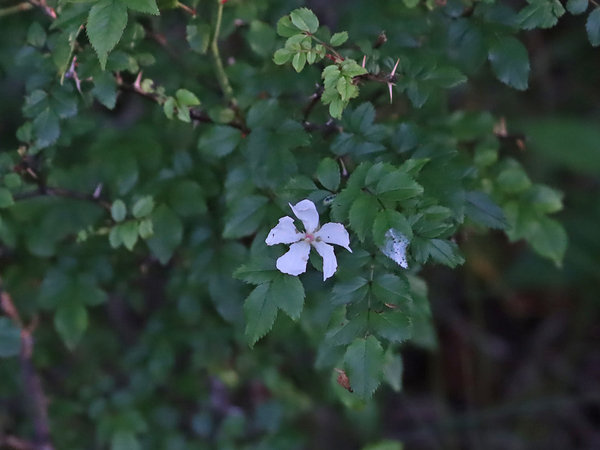
Rosa onoei var. oligantha ("Azumaibara")
Japanese name: アズマイバラ (東茨)
Scientific name: Rosa onoei var. oligantha
[Overview]
A deciduous shrub 1–2 m tall, common in southern Kanto, found in relatively dim, dry, rocky places such as slope forests and cliffs in hills and low mountains.
It sometimes hangs down from cliffs.
The stems branch freely, first growing upward and then spreading sideways in an arch, and the branches have straight thorns.
The leaves are alternate and odd-pinnately compound, 5–10 cm long, with 5–7 leaflets.
The leaflets are ovate-elliptical, 2–4 cm long, slightly glossy on the upper surface, and the leaf axis is hairless.
The leaf margins have sharp serrations.
The stipules are attached to the petiole up to their upper part, have no serrations, and have glandular hairs.
A short panicle at the branch tip bears several to a dozen or so white, 5-petaled flowers 2–3 cm across.
The flower stalk, hypanthium and outer surface of the sepals are hairless, while the inner side and margins of the sepals are densely covered with cottony hairs.
The sepals have 1–2 small lobes.
The fruit is ovoid-spherical, 0.6–0.8 cm across, and ripens red.
Details
Translated from our Japanese encyclopedia. If anything differs, the Japanese page is correct.