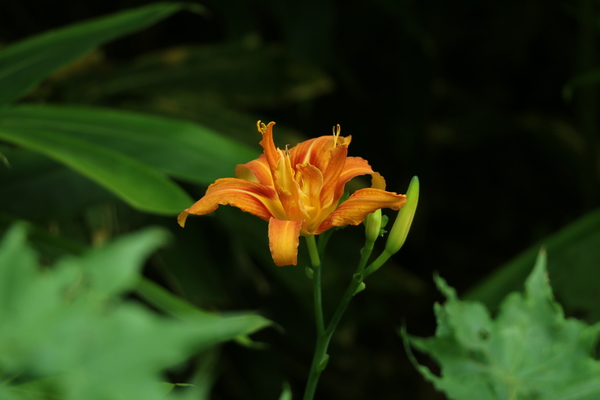
Japanese name: ヤブカンゾウ(藪萱草) Scientific name:Hemerocallis fulva var. kwanso
[Overview]
A perennial 50–100 cm tall, growing on river banks and in fields.
It has long creeping rhizomes, and the roots sometimes have spindle-shaped swellings.
The leaves arise from the base in two rows.
The leaves are simple and linear, 40–90 cm long and 2–4 cm wide.
A dichasial cyme is produced at the tip of the flower stalk, and orange-red double flowers are borne facing upward at the end of the branches.
The upper part of the flower stalk has small bracts.
The tips of the tepals are slightly recurved.
It does not set fruit.
[History]
It is thought to have been introduced from China in ancient times.
[Uses]
The buds, roots and leaves are used medicinally.
The young shoots, young leaves and flowers can be eaten.
[Cultivation]
Propagate by division.
It prefers a sunny, well-drained site rich in organic matter.
It is hardy, and when planted in a garden it grows well even if left alone.
Water thoroughly when the soil surface dries.
In addition to a base fertilizer, apply slow-release fertilizer once each in March–April and September–October.
Once the flowers are finished, remove the spent flowers promptly.
When the underground stems become crowded, the plant declines from the center of the clump, so in that case divide it.
Aphids can occur.