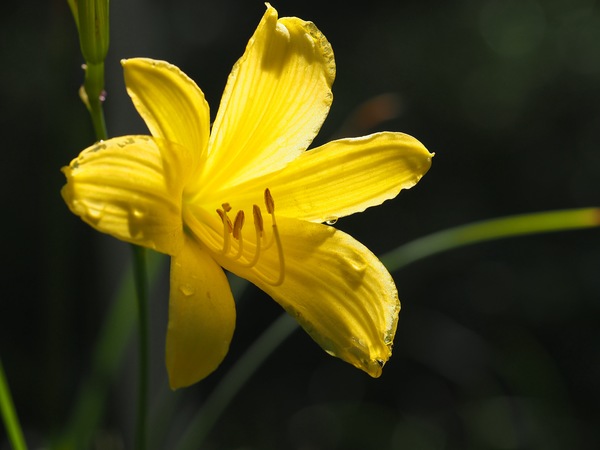
Hemerocallis minor(dwarf day lily, "Hosobakisuge")
Japanese name: ホソバキスゲ(細葉黄菅) Scientific name:Hemerocallis minor
[Overview]
A perennial 50–70 cm tall, found in pastures, woodland edges, grassy slopes, along valleys and similar places.
The roots do not have spindle-shaped swellings.
The leaves arise from the base and are arranged in two rows.
The leaves are simple and linear, 20–60 cm long and 0.3–1.5 cm wide.
A dichasial cyme at the tip of a 50 cm tall flower stalk bears lemon-yellow, 6-petaled flowers facing upward to sideways.
The tepals are 4–7.5 cm long and curve back slightly at the tips.
The flowers open in the evening and bloom for 1–2 days.
The fruit is an elliptical capsule 2–3 cm long.
[Uses]
In China the flowers are eaten.
[Cultivation]
Propagate from seed or by division.
It prefers a sunny, well-drained place rich in organic matter.
Water thoroughly when the soil surface dries.
In addition to basal fertilizer, apply slow-release fertilizer once each in March–April and September–October.
When the flowers are finished, promptly remove the spent flowers.
Aphids can occur.