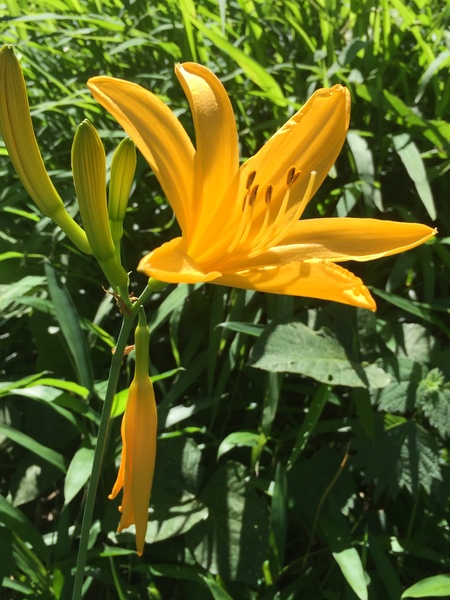
Hemerocallis dumortieri var. esculenta("Zenteika")
Japanese name: ゼンテイカ(禅庭花) Scientific name:Hemerocallis dumortieri var. esculenta
[Overview]
A perennial 60–80 cm tall, found in subalpine grasslands and on northern coasts.
It has a rhizome.
The leaves emerge from the base and are arranged in 2 rows.
The leaves are simple and linear, 60–70 cm long and 1.6–2 cm wide.
A dichasial cyme at the tip of a flower stem 60–80 cm tall bears orange-yellow six-petaled flowers, 3–10 at a time.
The tepals are 6.5–8 cm long, with tips curving back slightly.
The flowers open in the early morning and wither in the evening, lasting only one day.
The fruit is a broadly elliptical capsule.
[Uses]
The roots are used medicinally.
The young shoots, young leaves and flowers are edible.
[Cultivation]
Propagate by division.
It prefers a sunny, well-drained place rich in organic matter.
Water thoroughly when the soil surface dries.
In addition to fertilizer at planting, apply slow-release fertilizer once each in March–April and September–October.
Once the flowers have finished, remove the spent flowers promptly.
When the underground stems become crowded, the plant declines from the center, so divide it in that case.
Aphids can occur.